
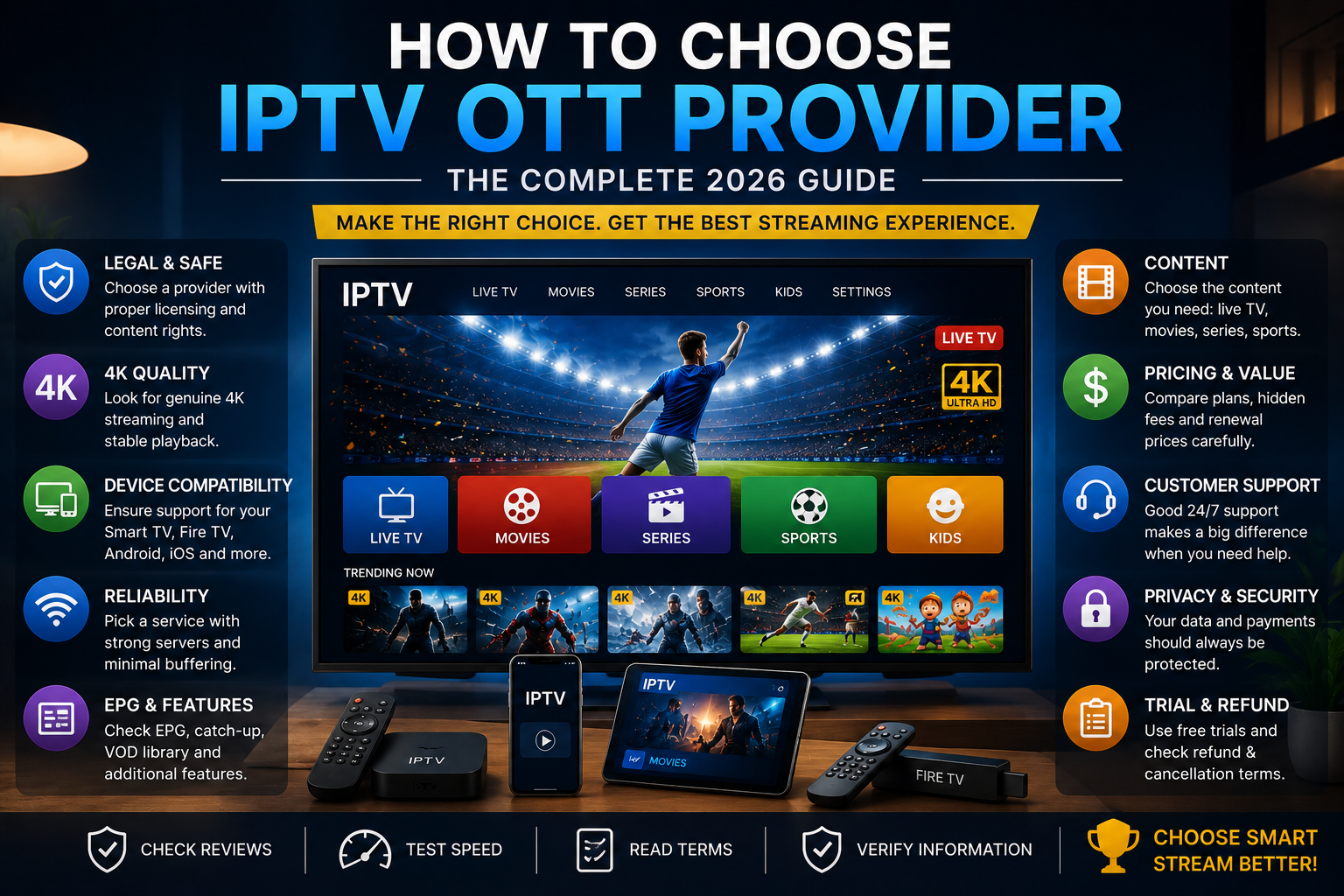
With so many internet-based television services available, it can be difficult to determine which factors actually matter. A provider may advertise thousands of channels, 4K streaming, multiple devices, and affordable plans, but those claims do not necessarily tell you how the service will perform in real-world conditions.
The better approach is to evaluate an IPTV OTT provider from several angles:
- Content and authorization
- Streaming quality
- 4K capability
- Device compatibility
- Reliability
- Application support
- Pricing
- Subscription terms
- Customer support
- Privacy and security
This guide explains how to choose an IPTV OTT provider and provides a practical checklist you can use before making a subscription decision.
What Is an IPTV OTT Provider?
IPTV stands for Internet Protocol Television and generally refers to television or multimedia content delivered through IP-based networks.
OTT, or Over-the-Top, describes content delivered through the internet rather than through a traditional television distribution method.
Although IPTV and OTT can describe somewhat different delivery models, consumers often encounter both terms when researching modern internet television.
The technology itself, however, does not determine whether a particular service is authorized to distribute the content it offers.
That is why choosing an IPTV OTT provider requires looking beyond technology and marketing.
If you want to understand the fundamentals first, our IPTV guide provides additional articles covering IPTV technology, devices, setup, streaming quality, and subscription considerations.
How to Choose an IPTV OTT Provider
There is no single provider that is automatically the best choice for every viewer.
The right service depends on your equipment, viewing habits, content requirements, internet connection, and budget.
A useful way to compare providers is to work through the following criteria.
1. Start With Your Own Viewing Requirements
Before comparing providers, determine what you actually need.
Ask yourself:
- Do I mainly watch live TV?
- Do I need movies and series?
- Is sports important?
- Do I need international programming?
- Do I want 4K?
- How many devices will I use?
- Do multiple people need to watch simultaneously?
- Do I need an Electronic Program Guide?
- Do I prefer monthly or longer subscriptions?
This prevents you from paying for features you will never use.
For example, a single viewer using one Smart TV may have very different requirements from a household where several people watch different content simultaneously.
2. Check Device Compatibility
Device compatibility should be one of the first things you verify.
Depending on the service, IPTV OTT applications may support platforms such as:
- Smart TVs
- Fire TV
- Android TV
- Android smartphones
- iPhone
- iPad
- Apple TV
- Windows
- macOS
- Compatible streaming devices
However, “multi-device support” does not always mean that every application has identical features on every platform.
Before subscribing, confirm that your specific device and operating system are supported.
Our Smart TV IPTV setup guide explains how the TV platform, application, internet connection, and legitimate service all work together during setup.
3. Evaluate 4K Support Carefully
If you own a 4K television, you may naturally want a provider that supports Ultra HD streaming.
However, you should distinguish between advertised 4K and genuine 4K content.
A proper 4K viewing experience requires:
- A genuine 4K source
- 4K-capable hardware
- A compatible application
- A 4K display
- Sufficient bandwidth
- Stable connectivity
A television can upscale lower-resolution content, but upscaling does not transform the original source into native 4K.
Our detailed Real 4K IPTV guide explains how to evaluate resolution, hardware, bandwidth, and playback stability when testing 4K IPTV.
A useful question to ask
Instead of asking only:
“Does this provider offer 4K?”
ask:
“Which content is actually available in native 4K?”
That distinction can make a significant difference.
4. Look Beyond Channel Count
One of the most common mistakes when comparing IPTV services is focusing almost entirely on the number of channels.
A huge channel count does not necessarily mean better value.
Instead, ask:
- Are the channels relevant to me?
- Is the content available consistently?
- Is the video quality good?
- Is the programming properly authorized?
- Is the EPG accurate?
- Does the application perform well?
A smaller, well-organized content selection can be more useful than a huge list containing channels you never watch.
5. Check Content Authorization
This is one of the most important factors when choosing an IPTV OTT provider.
IPTV is simply a method of delivering content. It does not automatically give a provider the right to distribute every television channel, movie, series, or sporting event.
Before subscribing, look for information about:
- The company operating the service
- Content rights
- Licensing information where applicable
- Geographic availability
- Terms and conditions
- Contact information
For UK-related services, Ofcom provides information about regulated Electronic Programme Guides and television services.
A transparent provider should make it reasonably clear what its service is, what it offers, and what terms apply.
6. Test Streaming Stability
A service can have impressive picture quality and still provide a poor experience if playback is unreliable.
When evaluating a provider, pay attention to:
Buffering
Does the video repeatedly stop to load?
Freezing
Does playback suddenly pause?
Connection Drops
Does the stream disconnect unexpectedly?
Channel Switching
How quickly does the application move between channels?
Peak-Time Performance
Does performance remain consistent during busy viewing periods?
If a legitimate trial is available, test the service during the same times and on the same equipment you normally use.
7. Understand Your Internet Requirements
Your own internet connection is an important part of the IPTV experience.
As a general reference:
| Video Quality | Approximate Starting Point |
|---|---|
| SD | 5 Mbps+ |
| HD | 10 Mbps+ |
| Full HD | 15 Mbps+ |
| 4K | 25 Mbps+ |
These are general guidelines rather than guarantees.
Actual performance can also depend on:
- Wi-Fi signal strength
- Router performance
- Network congestion
- Number of connected devices
- Video bitrate
- Device hardware
- Application performance
For 4K streaming in particular, sustained bandwidth and network stability are more important than a short speed-test result.
8. Examine the IPTV Application
The IPTV service and the application used to access it are not necessarily the same thing.
Some providers use third-party players, while others provide their own application.
Before choosing a provider, determine:
- Which application is required
- Whether it is available for your device
- Whether your login method is supported
- Whether EPG is available
- Whether subtitles are supported
- Whether the application is actively maintained
Applications should preferably be downloaded from official or trusted sources.
Our Smart TV setup guide also recommends checking the developer, compatibility, privacy information, permissions, and service requirements before installing an IPTV application.
9. Check the Electronic Program Guide
An Electronic Program Guide (EPG) can make live television much easier to navigate.
Depending on the service, it may display:
- Current programs
- Upcoming programs
- Program descriptions
- Channel information
- Start and end times
If EPG is important to you, test whether:
- The guide loads correctly
- Program information is accurate
- The schedule updates consistently
- Your application supports the required format
For UK viewers, Ofcom provides specific information about regulated EPG services and their role in presenting programme listings.
10. Check Multi-Device and Simultaneous Streaming Rules
There is an important difference between device compatibility and simultaneous connections.
A service may support Smart TV, Fire TV, Android, iOS, and PC while allowing only a limited number of simultaneous streams.
Before subscribing, check:
- Supported devices
- Number of simultaneous streams
- Additional connection costs
- Account-sharing rules
If several people in your household watch different content at the same time, this factor can be particularly important.
11. Compare the Real Subscription Cost
Don’t compare IPTV providers based only on the price displayed on the homepage.
Look at the complete cost.
Check:
- Monthly price
- Total subscription cost
- Billing frequency
- Renewal price
- Additional connection costs
- Refund conditions
- Cancellation terms
Our IPTV Subscription Cost guide explains why the effective monthly cost can be very different from the headline price and why stability should be evaluated before committing to a longer plan.
Simple rule
Compare total cost, not just the advertised monthly equivalent.
12. Decide Between Monthly and Longer Plans
Longer subscriptions can sometimes reduce the effective monthly price, but they also create a greater commitment.
A shorter plan may be preferable when:
- You are trying a provider for the first time
- You have not tested it on your actual device
- You are uncertain about the content
- Your viewing requirements may change
A longer plan may make more sense after you have already confirmed that the service works well for your setup.
The important point is to understand the refund and cancellation terms before making a longer commitment.
13. Use a Free Trial Properly
If a provider offers a legitimate IPTV free trial, don’t waste it by watching one channel for five minutes.
Use the trial as a structured test.
Test:
Your main device
Your normal internet connection
Different categories
Different times of day
HD and 4K where available
EPG
Channel switching
Application performance
If the service performs well under your normal viewing conditions, you have much more useful information than you would get from simply reading marketing claims.
14. Read the Free-Trial Terms
A free trial should always come with clearly understandable terms.
Before signing up, find out:
- How long the trial lasts
- Whether payment information is required
- What happens when the trial ends
- Whether automatic renewal applies
- What the regular price will be
- How cancellation works
The U.S. Federal Trade Commission recommends understanding the length of a free trial, the cancellation process, and what happens after the trial before providing payment information.
This is an important consideration regardless of which IPTV OTT provider you are researching.
15. Evaluate Customer Support
Customer support can make a major difference when something goes wrong.
Before subscribing, check whether the provider offers a clear way to ask questions.
You can ask about:
- Device compatibility
- Application requirements
- 4K support
- Trial conditions
- Billing
- Cancellation
Pay attention to the quality of the answer.
A provider that responds clearly to questions before purchase is generally easier to evaluate than one that provides only generic sales messages.
16. Review Privacy and Security
Before entering personal or payment information, look for:
- Privacy policy
- Terms of service
- Company information
- Secure payment processing
- Contact information
- Refund policy
Avoid entering unnecessary sensitive information into websites where the company identity and data practices are unclear.
A professional service should make its basic policies reasonably easy to find.
17. Check the Cancellation and Refund Policy
Before purchasing, understand exactly what happens if you decide to stop using the service.
Look for:
- Cancellation method
- Refund eligibility
- Refund period
- Renewal conditions
- Recurring billing information
The FTC also recommends understanding how to cancel before signing up for a subscription or trial.
Don’t wait until after a billing problem occurs to look for this information.
18. Consider Regional Content
Content availability can differ between countries.
If you are looking for UK, US, European, or international programming, check whether the provider actually offers the relevant content in your region and has the necessary rights to distribute it.
Consider:
- Local channels
- International channels
- Language options
- Sports availability
- Regional programming
Never assume that a channel advertised online is necessarily available everywhere.
19. Watch for Red Flags
When researching an IPTV OTT provider, pay attention to warning signs such as:
Unclear Company Information
You cannot determine who operates the service.
Unclear Pricing
The initial price is obvious, but renewal costs are difficult to find.
Missing Terms
There is no clear information about cancellation, refunds, or renewals.
Unsupported Claims
The provider makes claims that are difficult to verify.
Poor Communication
Customer support cannot answer basic questions clearly.
Unclear Content Authorization
There is no meaningful information about the provider’s rights to distribute its programming.
One warning sign does not automatically prove that a service is illegitimate, but several together should encourage additional research.
IPTV OTT Provider Comparison Checklist
Before choosing a provider, compare the following:
| Factor | What to Check |
|---|---|
| Content | Is it relevant to you? |
| Authorization | Are distribution rights explained? |
| Quality | HD, Full HD or genuine 4K? |
| Stability | Does playback remain consistent? |
| Devices | Is your hardware supported? |
| Application | Is the required app compatible? |
| EPG | Is the guide accurate? |
| Connections | How many simultaneous streams? |
| Price | What is the complete cost? |
| Renewal | What happens when the plan ends? |
| Cancellation | Is it clearly explained? |
| Refund | Is there a published policy? |
| Privacy | Are data practices explained? |
| Support | Can you reach the provider? |
| Transparency | Is company information available? |
A Simple Way to Compare IPTV Providers
If you want to make the process easier, follow these steps.
Step 1 — Define Your Requirements
Write down your devices, preferred content, quality requirements, budget, and number of users.
Step 2 — Check Compatibility
Confirm that the service supports your actual devices.
Step 3 — Check Content
Look for the channels and categories you genuinely need.
Step 4 — Verify Transparency
Review company information, terms, privacy policy, and content authorization.
Step 5 — Test the Service
Use a legitimate trial where available.
Step 6 — Test During Normal Viewing
Don’t test only during quiet hours.
Step 7 — Compare Total Cost
Look at the full subscription cost and renewal terms.
Step 8 — Evaluate Support
Ask a technical question before committing.
Step 9 — Make the Decision
Choose based on the complete experience rather than a single marketing claim.
Why Reliability Matters More Than Channel Count
Imagine two providers.
Provider A advertises an enormous channel list but frequently buffers during peak hours.
Provider B offers fewer channels but provides stable playback, accurate program information, compatible applications, transparent pricing, and responsive support.
For many viewers, Provider B may provide the better overall experience.
This is why reliability, relevance, and transparency should be part of your evaluation.
What Makes a Good IPTV OTT Provider?
A strong IPTV OTT service should make it easy for potential customers to understand:
- What the service provides
- Which devices are supported
- What video quality is available
- What the subscription costs
- How renewal works
- How cancellation works
- How customers receive support
- What information is available about content authorization
The more transparent these details are, the easier it is for consumers to make an informed decision.
Frequently Asked Questions
How do I choose an IPTV OTT provider?
Start by identifying your viewing requirements, then compare content, authorization, device compatibility, streaming quality, reliability, pricing, support, privacy, and subscription terms.
Should I choose an IPTV provider based on channel count?
No. Channel count is only one factor. Content relevance, streaming stability, quality, compatibility, and transparency are also important.
Is 4K important when choosing an IPTV provider?
If you own a 4K display, it can be important. However, genuine 4K also requires a suitable source, device, application, display, and network connection.
Should I use an IPTV free trial?
A legitimate free trial can help you test compatibility, stability, picture quality, application performance, and content before making a longer commitment.
How many simultaneous connections should I get?
It depends on how many people will watch different streams simultaneously. Check the provider’s specific connection policy.
What should I check in an IPTV subscription?
Look at the total price, renewal conditions, cancellation policy, refund terms, supported devices, content, quality, and customer support.
Is IPTV legal?
IPTV is a technology for delivering television over IP networks. The legality of a particular service depends on its content, distribution rights, and applicable laws.
What is the biggest mistake when choosing an IPTV OTT provider?
Focusing only on price or channel count. A better approach is to evaluate the complete service.
Final Thoughts
Knowing how to choose an IPTV OTT provider can save you from making a decision based only on advertising.
Start with your own requirements, then evaluate:
Content
Authorization
Device compatibility
Streaming quality
4K capability
Reliability
Application
Pricing
Support
Privacy
Cancellation and refund terms
If you are researching IPTV and 4K streaming, continue exploring the BuyIPTVfor4K Blog for practical guides covering Smart TV setup, 4K IPTV, subscription costs, and other IPTV topics.
You can also visit the BuyIPTVfor4K website to learn more about the service and review the information provided before making a subscription decision.
The goal should not simply be to find the cheapest IPTV OTT provider.
The better goal is to find a transparent, compatible, reliable service that fits your actual viewing needs and clearly explains its terms and content rights.