
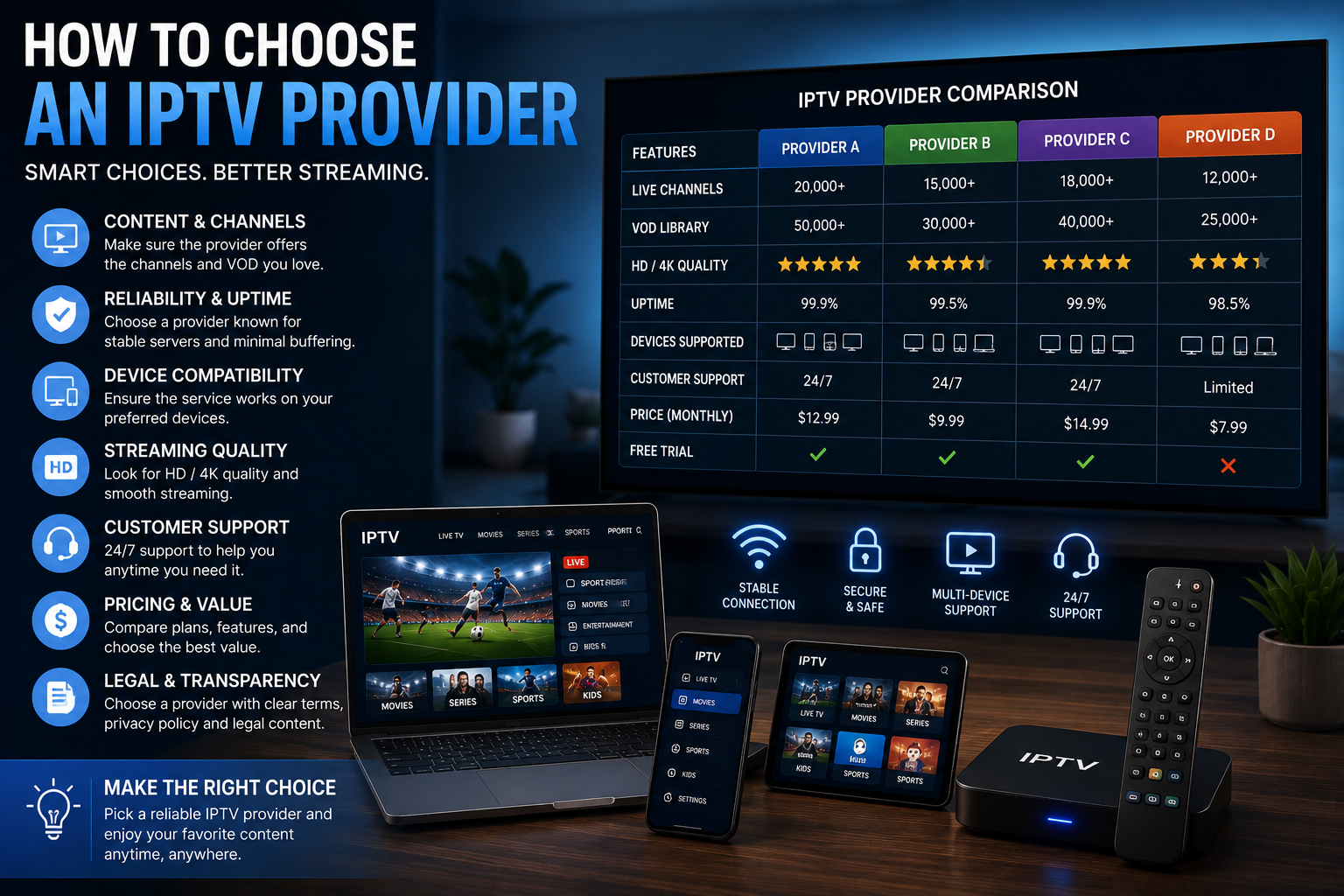
IPTV Provider Archives – How to Choose the Best
Internet Protocol Television can be a flexible way to watch or deliver TV-style content over broadband, but the result depends on the provider behind it. The best choice is not just the cheapest plan or the longest channel list. It is the iptv provider that fits your viewing habits, tech needs, budget, device support, and legal expectations.
This guide shows how to compare iptv service providers with a practical eye, whether you are a viewer, reseller, broadcaster, or operator looking at larger iptv solutions for operators.
What should you look for in an IPTV provider?
You should look for a provider that offers reliable streams, licensed or properly authorized content, responsive support, clear pricing, device support, and enough flexibility to match how you actually watch or distribute video. A strong iptv service provider makes the service feel simple. Channels load fast, catch-up and video on demand are easy to find, billing is clear, and help is there when something breaks. A weak provider may look good at first, but buffering, missing channels, poor docs, and weak rights can turn it into a bad deal.
The right decision starts with your use case. A casual viewer who wants live channels on a smart TV has very different needs from a business comparing iptv solutions for operators. Likewise, iptv streamers who care about sports, international channels, or multi-device access should judge providers differently from hotels, ISPs, residential communities, or media companies building a branded platform.
Before you compare features, define what best means for you. Is it picture quality? Uptime? Support? Content variety? Ease of setup? A predictable monthly cost? Once you know the answer, it becomes easier to ignore flashy claims and focus on the parts that affect daily use.

IPTV basics without the jargon
IPTV delivers TV and video over internet protocol networks instead of cable, satellite, or terrestrial broadcast. In simple terms, content travels over an internet connection to an app, set-top box, smart TV, phone, browser, or other compatible device. This delivery model can support live TV, video on demand, time-shifted viewing, catch-up TV, and interactive features.
That flexibility is why there are so many iptv providers serving different audiences. Some focus on consumers who want entertainment subscriptions. Others serve businesses that need managed platforms, middleware, encoding, delivery, billing, analytics, or white-label apps. Still others act as iptv suppliers that support resellers, integrators, or regional service providers.
The variety is useful, but it can also make the market confusing. Two services may both call themselves IPTV, yet one may be a simple subscription app while another is a complete headend and delivery platform. When comparing iptv subscription providers, always confirm what is included, what is optional, and what technical work stays on your side.
The main types of IPTV providers
Consumer subscription providers
Consumer-focused iptv subscription providers usually offer live channels, VOD libraries, or themed packages through an app or playlist. The best ones make setup clear, provide stable streams, explain device support, and publish simple renewal terms. They should also be open about content access and limits.
For individual viewers, this is often the easiest entry point. You usually want a simple account, a reliable app, enough channels you actually watch, and customer support that answers in plain language. Do not choose only by channel count, because a huge list is useless if your favorite channels buffer, vanish, or look poor.
Business and operator platforms
Businesses need a different level of control. IPTV solutions for operators may include content ingest, encoding, middleware, subscriber management, electronic program guides, access control, analytics, billing links, and branded apps. These systems are built for organizations that need to deliver video at scale, not just watch it.
If you are an operator, hotel group, campus, ISP, venue, or multi-dwelling property, your review should include infrastructure, service-level expectations, integration support, and long-term growth. A good platform partner should help you understand deployment, user management, monitoring, and maintenance before you commit.
Resellers, distributors, and suppliers
Some iptv suppliers serve resellers or businesses that package IPTV under their own brand. This can help you enter the market fast, but it adds another layer of due diligence. You need to know who controls the platform, who handles outages, who owns the customer relationship, and what happens if the upstream provider changes terms.
In this model, documentation and support matter even more. If you are responsible to your customers, you need clear communication from the supplier behind the scenes.
Reliability is the feature you notice every day
Reliability is the foundation of a good IPTV experience. A service can offer thousands of channels, low prices, and a polished app, but if streams freeze during peak hours, the value drops fast. For viewers, reliability means channels open without constant buffering, audio stays in sync, and the service works well during the programs you care about most.
For operators, reliability is broader. It includes uptime, monitoring, redundancy, failover planning, network performance, and support escalation. If IPTV is part of your customer-facing service, downtime hurts your reputation as much as the provider’s.
When evaluating iptv service providers, test them under real conditions. Do not judge performance only on a weekday afternoon if you mostly watch weekend sports or evening shows. If a trial is available, use it on your actual devices, home network, or business environment.
A useful reliability checklist includes:
- Test live channels at different times of day, especially during peak viewing periods.
- Check how quickly streams start and whether channel switching feels smooth.
- Watch for audio delay, subtitle problems, freezing, or sudden quality drops.
- Try the service on Wi-Fi and, if possible, a wired connection.
- Confirm whether the provider offers status updates during outages.
- Ask business providers about redundancy, monitoring, and support escalation.
Reliability is not only a technical issue. It is also a communication issue. A provider that explains outages clearly and responds quickly is easier to trust than one that leaves users guessing.
Content quality matters more than channel count
Many people compare iptv providers by looking at channel lists first. That is fair, but it can be misleading. A smaller package with the channels you actually watch, steady picture quality, and a usable guide may be better than a huge package filled with duplicates, dead streams, or content you never open.
Look closely at the mix. Do you need local channels, international programming, sports, movies, children’s content, news, niche entertainment, or on-demand libraries? Are catch-up features available for the channels you care about? Is the program guide accurate enough to use comfortably?
Picture quality also matters. HD and UHD labels only help if the streams are stable and your device, internet connection, and screen support them well. A clean, steady HD stream often feels better than a higher-res stream that keeps buffering.
For organizations, rights and licensing should be part of the conversation from the start. Do not assume that a platform provider automatically includes content rights, and do not assume that a content package is fit for commercial use. Ask direct questions, document the answers, and involve legal or compliance support when needed.
Is the IPTV service legal and properly licensed?
A legitimate IPTV service should have the rights to distribute the content it offers, and a responsible provider should be able to explain its model clearly. If a service promises premium channels, sports, movies, or global packages at a price that seems unreal, pause and investigate. Choosing a properly authorized iptv service provider helps protect you from sudden shutdowns, weak accountability, privacy risks, and legal trouble.
For consumers, legality can be hard to judge because many services use polished websites and apps. Still, there are warning signs. Be cautious with providers that refuse to share company information, rely only on informal messaging apps, offer no terms of service, or make vague claims about all channels worldwide without explaining rights.
For businesses, the bar should be even higher. If you are reselling, distributing, or showing content to customers, guests, residents, or subscribers, you need confidence that the content and platform fit your use case. Keep written records of agreements, rights, responsibilities, and support promises.
Practical legal and trust checks include:
- Review the provider’s terms of service, privacy policy, and refund policy.
- Look for clear company identity, support channels, and billing information.
- Ask how content rights are handled for your region and use case.
- Avoid providers that pressure you to pay through unusual or one-way methods.
- Be skeptical of unrealistic promises, especially around premium content.
- For commercial deployments, get professional advice before signing or reselling.
A trustworthy provider will not be offended by reasonable questions. In fact, clear answers are part of what separates serious providers from risky shortcuts.
Device support shapes the experience
The best IPTV service is the one that works smoothly on the devices you already use. Device support may include smart TVs, Android TV devices, Apple TV, streaming boxes, tablets, smartphones, web browsers, set-top boxes, or hotel systems. Before subscribing, confirm not only whether the service runs on your device but also how easy it is to install, update, and fix.
Apps matter because they are the interface you use every day. A provider may have strong content but a frustrating app, or a good app on one platform and a weak one on another. Test navigation, search, favorites, parental controls, subtitles, guide loading, and playback controls if they matter to you.
For operators, device strategy is a big planning choice. You may need branded apps, managed set-top boxes, browser access, mobile support, or links with current customer equipment. IPTV solutions for operators should be judged not just by today’s launch needs but also by future device support, updates, and user management.

Support is part of the product
Customer support is easy to overlook until something goes wrong. Then it becomes one of the most important parts of the product. Good support helps with setup, login issues, buffering, app updates, billing questions, device changes, and outage notices.
When comparing iptv service providers, pay attention to how they communicate before you buy. Do they answer questions clearly? Do they provide setup guides? Are support hours listed? Is there a ticket system, email address, phone number, live chat, or knowledge base? A provider that is hard to reach before payment may not become easier to reach afterward.
For businesses, support expectations should be written into the agreement. Ask about onboarding, training, escalation paths, maintenance windows, monitoring tools, and response times. If your customers depend on the service, you need more than casual troubleshooting.
Good support often looks like:
- Clear setup instructions for each supported device.
- Fast acknowledgement when issues are reported.
- Practical troubleshooting steps rather than vague replies.
- Honest updates during service interruptions.
- Documentation that your team or household can follow.
- A defined process for billing, renewals, and cancellations.
Support quality is also a clue about the provider’s maturity. Serious iptv suppliers and platform partners usually invest in documentation because it reduces confusion for everyone.
Pricing should be clear, not just low
Price matters, but the lowest price is rarely the full story. IPTV costs may vary based on content packages, number of connections, devices, video quality, catch-up features, video on demand access, branded apps, platform modules, support levels, or contract length. What looks cheap at first may become frustrating if important features are missing.
For viewers, compare the total value. If one iptv provider costs a bit more but offers better stability, easier setup, and responsive support, it may be the better choice. Also check whether the subscription renews automatically, whether refunds are available, and whether multiple connections are included or billed separately.
For operators, pricing can involve setup fees, licensing, platform usage, bandwidth, support, integrations, custom work, and growth tiers. Ask for a clear breakdown so you can model costs as your subscriber base or viewing hours increase. A platform that works for a pilot may need different economics when it scales.
When reviewing pricing, ask:
- What exactly is included in the advertised price?
- Are there limits on devices, connections, regions, or viewing hours?
- Are setup, support, upgrades, or branded apps extra?
- What happens when the subscription expires?
- Is cancellation simple and clearly explained?
- For businesses, how does pricing change as usage grows?
Clear pricing builds trust. Confusing pricing creates friction before the service even starts.
How do you compare IPTV providers fairly?
Compare providers by scoring them against the same criteria: legality, reliability, content relevance, device support, customer service, pricing clarity, security, and growth. This approach keeps you from getting distracted by one strong feature while missing a weak one elsewhere. A fair comparison also gives you a record of why you chose one provider over another.
Start with a shortlist rather than trying to evaluate every option online. Many people search broad phrases like iptv providers, iptv service providers, or even iptv provider Archives – when browsing older posts, directories, or saved resources. That can help you find options, but your final choice should come from direct testing, not search results alone.
Use a simple scoring process:
- Define your must-haves. List the channels, features, devices, regions, and support expectations you cannot compromise on.
- Separate needs from nice-to-haves. A polished interface is valuable, but it should not outrank legal clarity or stable streaming.
- Test real performance. Use a trial or short-term plan when available, and test at the times you normally watch.
- Check provider transparency. Look for clear policies, contact information, setup instructions, and billing terms.
- Evaluate support before subscribing. Ask a practical question and judge the clarity, speed, and professionalism of the response.
- Review long-term fit. Consider renewals, device changes, household needs, business growth, and future feature requirements.
This method works for individual viewers and businesses because it turns a crowded market into a manageable decision. Instead of asking, Which provider has the most? ask, Which provider fits best and carries the least risk?
Security and privacy deserve attention
IPTV services involve accounts, devices, viewing habits, payment information, and sometimes personal data. That makes privacy and security important, even if the service seems simple. A responsible provider should use secure account practices, explain how data is handled, and avoid asking for unnecessary access to your devices or information.
Consumers should be careful with unknown apps, odd installation files, and providers that require risky device settings. If you need to sideload an app, understand what you are installing and where it came from. Keep devices updated, use strong passwords, and do not reuse credentials from important accounts.
Businesses should take a formal approach. Ask about user data, access controls, administrative permissions, logging, platform security, and integration requirements. If the IPTV platform connects to billing systems, customer portals, hotel management tools, or internal networks, a security review is not optional.
A basic safety checklist includes:
- Use unique passwords for IPTV accounts and admin portals.
- Keep apps, devices, and firmware updated.
- Avoid sharing account credentials casually.
- Review privacy policies before entering payment details.
- Be cautious with unofficial apps or unknown installation files.
- For operators, limit admin access to people who truly need it.
A provider that treats security seriously gives you another reason to trust the service over time.
Growth for operators and expanding services
If you are evaluating IPTV for a business, growth should be part of the first conversation. A platform may work well for a small launch but struggle as viewer numbers, content libraries, device types, or geographic reach grow. Good iptv solutions for operators are built with growth in mind, including monitoring, modular features, and flexible integration.
Growth is not just about more users. It can also mean adding packages, launching branded apps, supporting extra languages, linking billing, adding analytics, or serving new customer groups. A provider that understands your roadmap can help you avoid rebuilding the platform too soon.
When speaking with platform vendors or iptv suppliers, describe your current needs and next steps. Ask how onboarding works, how updates are managed, how customers are provisioned, and what support is available during growth periods. If the provider cannot explain the path from small launch to larger operation, keep looking.
For operators, useful questions include:
- How does the platform handle subscriber growth?
- What monitoring and analytics are available?
- Can the service integrate with existing billing or customer systems?
- Are branded apps, custom interfaces, or multi-tenant features available?
- How are content updates, channel changes, and outages communicated?
- What technical support is available during launch and peak usage?
Growth is easier when your IPTV base is built for it from the beginning.
Red flags that should make you pause
Some warning signs are small snags. Others are reasons to walk away. If a provider cannot explain what it offers, how billing works, where support happens, or whether content is properly authorized, the risk may outweigh the savings.
Be especially cautious when a service depends on urgency. Phrases like pay now before the price disappears or lifetime access for a tiny one-time fee should prompt more questions. IPTV depends on ongoing infrastructure, support, content management, and updates, so offers that ignore those facts may not last.
Common red flags include:
- No clear company information or support channel.
- Unrealistic promises about premium content at extremely low prices.
- No terms of service, privacy policy, or refund explanation.
- Poor setup instructions or inconsistent communication.
- Pressure to use unusual payment methods.
- Frequent channel downtime during a trial.
- Apps from unclear sources that require risky installation steps.
- No documentation for business or reseller arrangements.
A good rule is simple: if the provider makes you work too hard to understand the basics, it may not be the right partner.
A practical decision checklist
Once you have narrowed your options, use one final checklist before you commit. This keeps the choice grounded and lowers the chance of picking a service based on marketing alone.
Before you subscribe or sign, confirm that:
- The provider fits your actual viewing or business use case.
- The content package includes what you need, not just a long channel list.
- The service works well on your preferred devices.
- Stream quality is stable during your normal usage times.
- Pricing, renewals, cancellations, and limits are clear.
- Support is reachable and helpful.
- Content rights and usage permissions are understood.
- Security and privacy practices are acceptable.
- For operators, the platform can grow with your roadmap.
- You have tested enough to feel confident, not just hopeful.
This checklist is meant to be practical. The goal is not to find a perfect provider in theory, but to choose a dependable service that performs well in your real environment.
The best choice is the one that fits your context
Choosing among iptv providers becomes easier when you stop chasing the biggest claims and start measuring the things that shape everyday use. Reliability, content relevance, legal clarity, device support, support quality, pricing transparency, and security matter more than a crowded channel list or a flashy promise.
For individual viewers, the right iptv service provider should make watching simple, steady, and comfortable. For businesses, resellers, and operators, the right partner should also support growth, compliance, integrations, and customer experience. Take time to compare, test, and ask direct questions before you commit.
IPTV can be a powerful and convenient way to deliver modern video experiences, but only when the provider behind it is trustworthy and aligned with your needs. Choose carefully, and you are far more likely to get a service that works not just on day one, but over the long run.
Q&A
Question: How should I start comparing IPTV providers if there are so many options?
Short answer: Start with your use case and your must-have requirements before you look at channel lists or prices. A casual viewer may care most about stable live channels, device support, and simple setup, while an operator or reseller may need growth, licensing clarity, analytics, billing links, and support escalation. Once you know what best means for your situation, you can compare providers against the same criteria instead of being distracted by flashy claims.
Question: Why is reliability more important than a large channel list?
Short answer: A long channel list does not matter if the streams buffer, freeze, disappear, or perform poorly during peak viewing times. The guide recommends testing providers under real conditions, such as evenings or weekend sports, and checking stream start time, channel switching, audio sync, subtitle performance, and outage communication. A smaller, stable package with the content you actually watch is often more valuable than a huge but spotty lineup.
Question: What are the main warning signs of a risky IPTV service?
Short answer: Red flags include unclear company information, no terms of service or privacy policy, unrealistic promises about premium content at very low prices, unusual payment methods, poor setup instructions, frequent downtime during a trial, and apps from unclear sources. The article also warns against providers that cannot explain content rights, billing, support, or usage permissions. If a provider makes basic information hard to verify, it may not be a trustworthy choice.
Question: What should businesses and operators evaluate beyond basic IPTV features?
Short answer: Businesses should look beyond content and app access to assess platform reliability, growth, legal permissions, integrations, support agreements, monitoring, redundancy, billing systems, user management, and security. Operators, hotels, ISPs, campuses, venues, and resellers need a provider that can support growth and customer-facing service expectations. Written agreements, clear escalation paths, and documented content rights are especially important for commercial deployments.
Question: How can I test whether an IPTV provider is a good fit before committing?
Short answer: Use a trial or short-term plan when available and test the service on your real devices, network, and normal viewing schedule. Check whether your preferred channels work consistently, whether the app is easy to use, whether support responds clearly, and whether pricing, renewals, cancellations, and limits are transparent. For business use, also ask about onboarding, monitoring, integrations, growth tiers, and support during launch or peak use.
3 Replies to “IPTV Provider Archives – How to Choose the Best”