
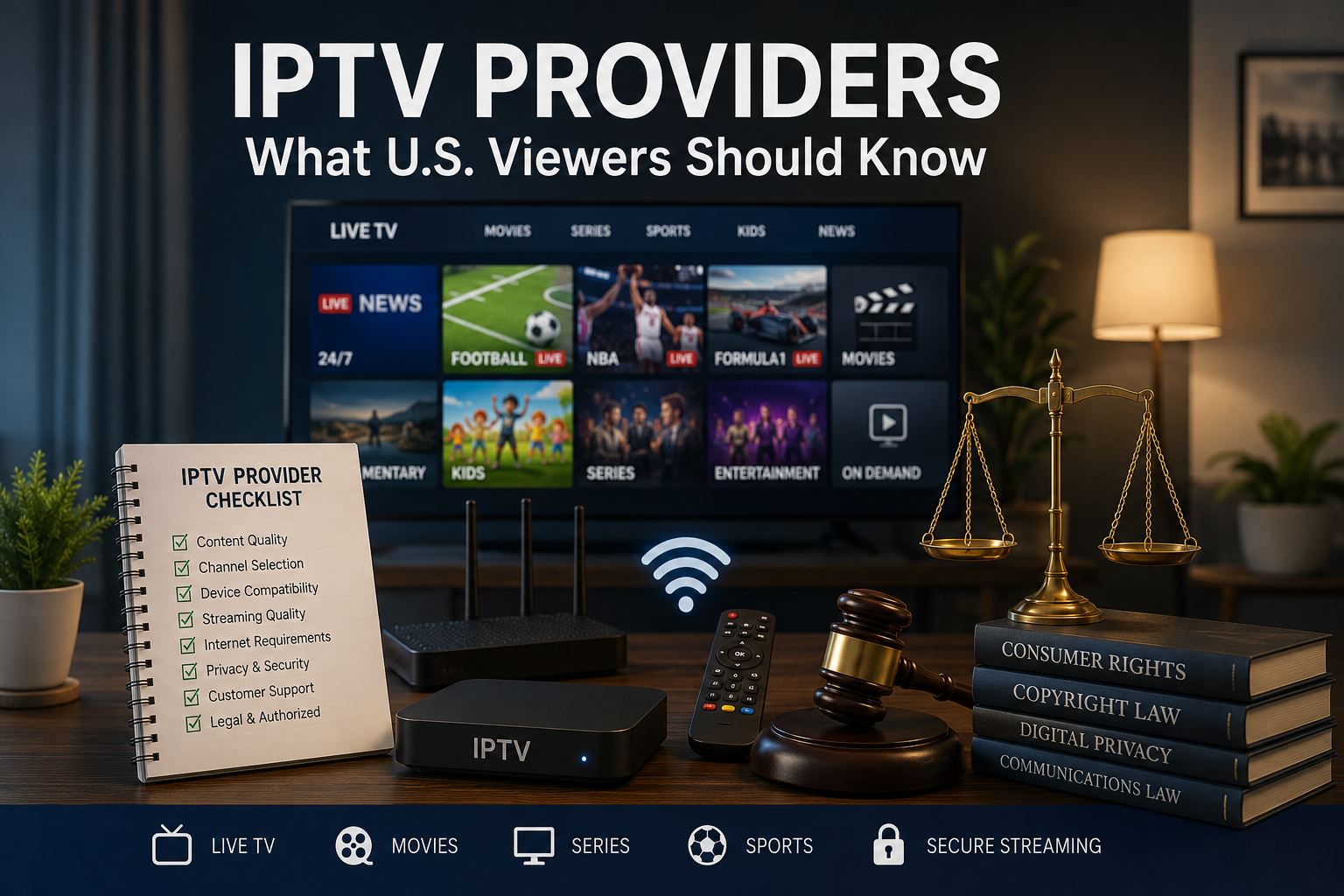
The number of IPTV providers available to viewers in the United States has grown as internet-connected televisions and streaming devices have become increasingly common. IPTV allows television and video content to be delivered through internet-based networks rather than relying exclusively on traditional broadcast, cable, or satellite systems.
However, IPTV is not simply about the number of channels available. Device compatibility, streaming quality, internet performance, privacy, service transparency, and content authorization are all important factors when researching internet-based television.
This guide explains how IPTV providers work and what viewers should understand before evaluating different services.
What Are IPTV Providers?
An IPTV provider is a service that delivers television or video programming through an IP network.
Depending on the platform, internet-based television can include:
- Live television
- Movies
- TV series
- News
- Sports
- Documentaries
- Entertainment
- On-demand video
The exact content depends on the provider, its distribution agreements, and the programming available through its platform.
For readers who are new to the subject, our What Is IPTV? guide provides additional information about the technology.
How Do IPTV Providers Deliver Content?
A simplified IPTV delivery process looks like this:
Content source → Encoding → IP network → Application or player → Compatible device → Television
The content is prepared for digital transmission and delivered through an internet connection.
The final viewing experience can depend on several components, including:
- Content source quality
- Internet connection
- Network stability
- Streaming application
- Device performance
- Video resolution
This is why two viewers can sometimes have different experiences even when watching similar content.
Why Are IPTV Services Popular in the USA?
Internet-based television can offer flexibility for households that use several connected devices.
Depending on compatibility, viewers may use:
- Smart TVs
- Android TV devices
- Google TV
- Streaming devices
- Computers
- Smartphones
- Tablets
Instead of relying on a single traditional television setup, internet-based services can potentially be accessed across multiple compatible screens.
For a broader introduction to the American IPTV market, see our IPTV USA guide.
Device Compatibility Is Important
One of the first things to consider when researching an IPTV provider is whether the service works with your preferred device.
Compatibility may vary according to:
- Operating system
- Television model
- Application
- Device generation
- Supported video formats
For example, an application available on Android TV may not necessarily be available on every Smart TV platform.
IPTV and Smart TVs
Smart TVs can provide a convenient way to access compatible internet television applications.
Before using an application, check:
- The TV operating system
- Application availability
- Developer information
- Supported resolutions
- Device requirements
Our IPTV Smart TV Setup guide provides additional information about Smart TV compatibility and setup considerations.
IPTV on Fire TV Devices
Streaming devices can provide another option for viewers whose television does not directly support a particular application.
Fire TV devices, Android TV hardware, and other streaming platforms can support different applications depending on their software environment.
Compatibility should always be checked before installing an application.
For additional technical information, see our IPTV Firestick Setup guide.
Internet Speed and IPTV Streaming
A stable internet connection is essential for internet-based television.
The amount of bandwidth required can depend on:
- Video resolution
- Bitrate
- Number of simultaneous streams
- Network activity
- Wi-Fi performance
A household with several people streaming video at the same time may need more network capacity than a household with a single active stream.
Speed vs Stability
Internet speed is not the only factor.
A connection can have a high advertised speed but still experience interruptions if:
- Wi-Fi coverage is weak
- The router is overloaded
- Network congestion is high
- Other devices are using substantial bandwidth
For more information, read our Internet Speed for IPTV guide.
Understanding HD and 4K IPTV
Modern televisions support a variety of video resolutions.
Common formats include:
- SD
- HD
- Full HD
- 4K UHD
A 4K television does not automatically make every stream 4K.
For genuine 4K playback, the relevant components need to support the required resolution, including the source content, application, device, television, and network.
Our 4K IPTV USA guide provides additional information about 4K streaming and the factors that influence picture quality.
How to Compare IPTV Providers
When researching different IPTV providers, looking only at the advertised channel count can be misleading.
A more useful comparison considers several areas.
| Factor | What to Consider |
|---|---|
| Content | What programming is available |
| Compatibility | Supported devices and platforms |
| Quality | HD and 4K capabilities |
| Reliability | Consistency of playback |
| Internet | Network requirements |
| Privacy | Data collection and handling |
| Support | Available technical assistance |
| Transparency | Clear service information |
| Authorization | Rights to distribute content |
This approach gives a more complete picture of an internet television service.
Content Authorization Matters
IPTV is a technology for delivering video through IP networks. The technology itself does not determine whether a particular provider is authorized to distribute specific programming.
When researching an IPTV service, viewers should therefore look for transparent information about the source and distribution rights of the content.
The U.S. Copyright Office provides information about copyright protection and the rights associated with copyrighted works.
The FCC also provides information about communications services and consumer issues in the United States.
Privacy and Security
Privacy is another important consideration when researching online television services.
An application or platform may process:
- Account information
- Device information
- Usage data
- Payment information
- Technical information
Before using an unfamiliar application, review its privacy policy and check who operates it.
It is also sensible to obtain applications from trusted sources and keep your device software updated.
Common IPTV Problems
Even a technically legitimate streaming service can experience occasional problems.
Buffering
Buffering may result from network congestion, weak Wi-Fi, limited bandwidth, device limitations, or problems affecting the streaming source.
Poor Picture Quality
Low-quality video can be caused by the source resolution, application settings, device capabilities, or network performance.
Application Compatibility
An application may work on one operating system but not another.
Network Congestion
Other devices using the same internet connection can affect available bandwidth.
A Simple IPTV Provider Checklist
When researching an IPTV provider, consider these questions:
- What type of programming does it provide?
- Does it support your preferred device?
- What video resolutions are available?
- What internet requirements does it have?
- Are the service terms clear?
- Is a privacy policy available?
- Is customer support identifiable?
- Is information about content authorization available?
- Is the application obtained from a trustworthy source?
- Does the service clearly explain how its platform works?
These questions can help you evaluate internet television services more systematically.
Frequently Asked Questions
What is an IPTV provider?
An IPTV provider is a service that distributes television or video programming through IP-based networks.
Can IPTV providers support Smart TVs?
Yes, compatible IPTV applications can work on supported Smart TVs. Compatibility depends on the television, operating system, application, and service.
Can IPTV providers offer 4K?
IPTV technology can support 4K when the source, application, device, television, and internet connection support the required specifications.
Does IPTV require internet access?
Yes. IPTV relies on IP networks to transmit television and video content.
Is every IPTV provider authorized to distribute its content?
Not necessarily. Authorization depends on the provider’s rights and agreements concerning the content it distributes.
What should viewers compare?
Content, compatibility, streaming quality, network requirements, privacy, support, transparency, and content authorization are useful comparison criteria.
Final Thoughts
The growing number of IPTV providers reflects the broader shift toward internet-based television in the United States.
However, choosing or evaluating an IPTV service should involve more than comparing channel numbers. Device compatibility, internet performance, video quality, privacy, transparency, and content authorization all deserve attention.
Understanding these factors can help viewers better evaluate how internet television works and what to look for in a modern streaming setup.
For more educational resources about IPTV technology, devices, streaming quality, and internet requirements, visit BuyIPTVfor4K.
One Reply to “IPTV Providers in the USA: What Viewers Should Know”