
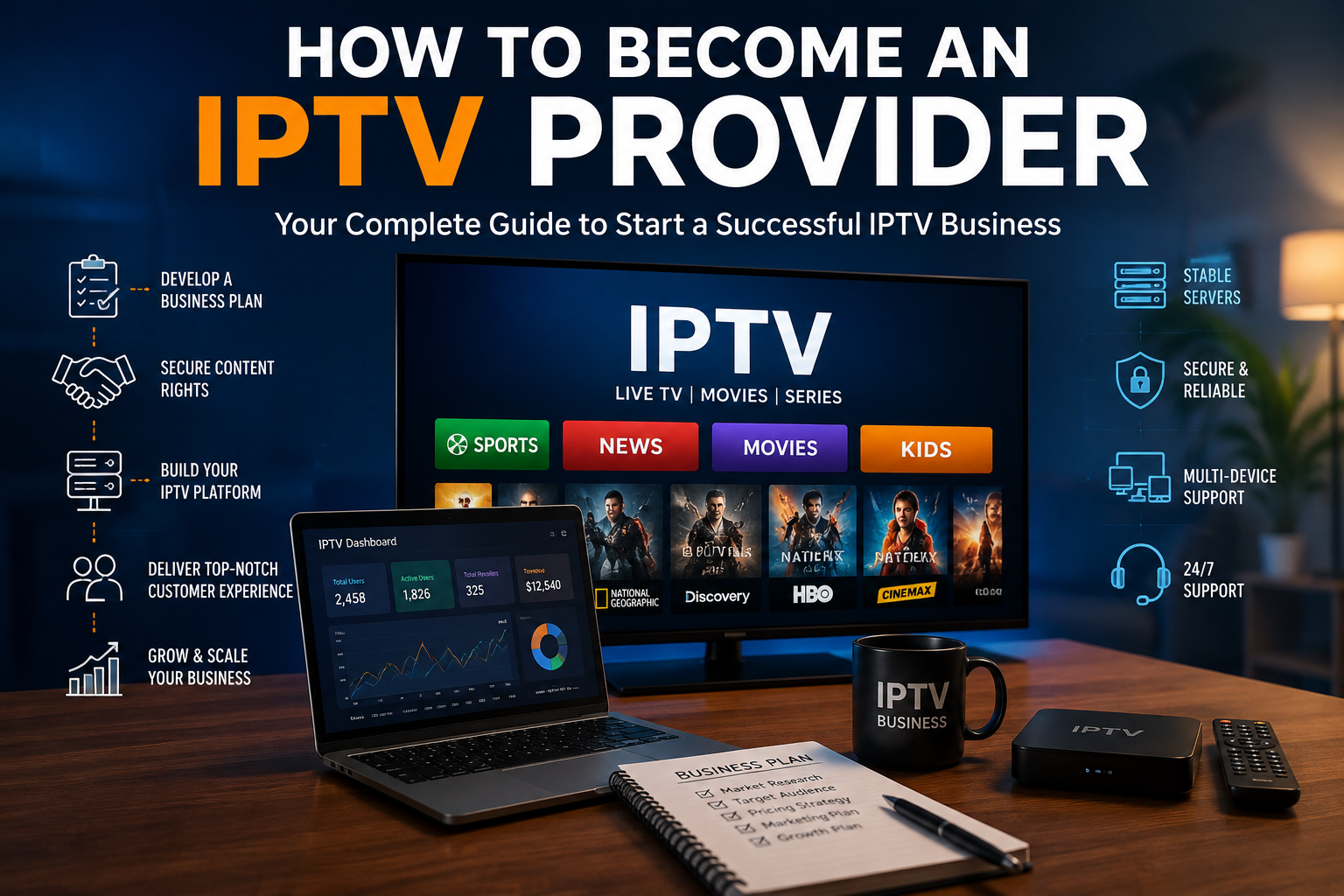
How to Become IPTV Provider: A Simple Guide
If you want to know how to become iptv provider, start with rights, a clear IPTV business plan, and a simple launch path. This also answers how to start a iptv business without overspending.
A real IPTV service provider is more than a server and a channel list. You need legal content, stable delivery, billing, support, and a product that viewers can use with little friction. This guide shows how to start IPTV business work the right way, whether you plan to build from scratch or become IPTV reseller first.
How do you become an IPTV provider?
You become an IPTV provider by combining three parts: rights to share content, a platform that streams well, and a model that turns viewers into paying users. You also need app access, payment flow, customer support, and retention plans from day one.
If you search how to become an iptv provider or how to become a iptv provider, you will find both solid advice and bad shortcuts. Be careful. A business built on illegal feeds, weak panels, or vague reseller rights can fail fast and bring legal risk.
Pick the service type first:
- Live TV packages: real-time channels with the hardest licensing and uptime demands.
- Video on Demand: films, shows, courses, sports archives, faith content, or niche libraries.
- Time-shifted TV: replay access after the live window, if your rights allow it.
- Near VoD: scheduled content that starts at fixed times.
- Hybrid IPTV and OTT delivery: a TV-like user feel with apps and cloud delivery.

The best path is usually narrow, not broad. A niche service can often compete through depth, community, language, rarity, or convenience. That is how smaller brands build a real edge against bigger streamers.
Build the IPTV business plan before the platform
An IPTV business plan keeps you from buying tools before you know the business. It should define your audience, the content they want, the rights you can secure, the price they will pay, and the service level you can support.
Start with market position. A general entertainment platform needs a large content budget and strong brand edge. A niche service can often win with depth, community, language, rarity, or convenience. A local sports service, for example, may need only a few channels if it offers the matches, commentary, replays, and fan tools that matter most.
Your plan should cover:
- Audience definition Identify devices, languages, habits, and budget.
- Content strategy Decide on live, on-demand, original, licensed, user-made, or mixed.
- Legal route List the rights holders or partners you must contact. Do not assume content is available for reuse just because it can be streamed somewhere online.
- Technology model Choose custom build, white label, OTT partner, or reseller route.
- Revenue model Estimate subscriptions, pay-per-view, ads, sponsorships, reseller credits, or bundles.
- Operating costs Include licensing, servers, storage, bandwidth, CDN use, app development, middleware, payments, support, marketing, and upkeep.
- Growth plan Plan for more viewers, channels, languages, apps, and regions. Growth should be planned early, not patched later.
This also answers how to start a iptv business without overspending. You may decide to begin with a narrow VoD service, a private network, or a reseller model while you test demand.
Licensing is the line between a business and a liability
Content rights are not optional. If you stream live channels, films, sports, music, or recorded shows, you need permission from the rights holder or an approved distributor. Those deals define where you can stream, which devices can play the content, whether replay is allowed, and how revenue is shared.
This is where many new operators slip. They focus on panels, apps, and channel lists before they check the rights. A true IPTV service provider should keep clear records and get legal help before launch, especially across regions or with premium content.
Important licensing questions include:
- Do you have rights for live streaming, on-demand viewing, or both?
- Are rights limited by country, language, device, or customer type?
- Can users record, replay, pause, or time-shift the content?
- Can you earn through subscriptions, ads, or pay-per-view?
- Do you need music, sports, performance, or broadcast-specific permissions?
- What reporting does the rights holder need?
- What happens if a license ends or a title must be removed fast?
If you create original content, you still need contracts with creators, hosts, performers, editors, and anyone whose work appears. Clear rights protect your platform and your partners.
What technology do you need to start an IPTV business?
To start an IPTV business, you need a stream flow that captures or stores content, encodes it, sends it through servers or a CDN, manages users and subscriptions, and plays well on customer devices. The exact stack depends on budget, content type, and scale, but the core parts are similar.
At a basic level, your platform needs to ingest video, process it, secure it, deliver it, and measure performance. Live content needs low-lag handling and monitoring. On-demand content needs storage, metadata, search, thumbnails, categories, and playback controls.
Core infrastructure components
- Cloud or VPS servers: Host app parts, admin tools, APIs, databases, or origin streams.
- Web server software: Tools like NGINX help serve traffic well.
- Encoding tools: Tools like FFmpeg convert video for different devices and speeds.
- Streaming protocols: HLS is common for adaptive streaming. RTMP is often used for ingest before playback.
- Middleware: The working layer for user accounts, subscriptions, billing rules, channel packages, access control, and device management.
- Content delivery network: A CDN reduces buffering by placing streams nearer to viewers.
- Player and apps: Viewers need smooth playback on mobile, browser, smart TV, set-top box, or tablet.
- Analytics and monitoring: Track uptime, buffering, starts, watch time, churn, failed payments, and support issues.
Build for the viewer, not just the server
A stream that works is not always a good service. Viewers judge your brand by app speed, search, buffer rate, payment flow, and support response.
A custom IPTV app can help you shape the user experience instead of relying only on a generic player. It can hold your brand, categories, search, favorites, parental controls, profiles, in-app sign-up, and support links. It also adds cost and upkeep, so it should match your stage of growth.
For an early launch, you might start with web and mobile, then add smart TV and set-top box apps when demand is proven. For a premium service, app quality may be part of the product from day one.
IPTV, OTT, and reseller models are different paths
Many people use IPTV and OTT as if they are the same. The business impact can be different. Traditional IPTV often means TV over a managed or operator network, sometimes with set-top boxes and private tools. OTT delivery sends video over the open internet through apps, browsers, and connected devices.
For many founders, OTT style delivery is more practical. It is flexible, cloud friendly, and easier to scale across devices. You can still offer live channels, guides, and on-demand libraries, but the setup is closer to a modern streaming stack than a closed telecom network.
The reseller model is another path. If you want to become IPTV reseller, you usually sell access to an existing platform under set terms. That cuts technical work, but it also limits control over content, uptime, pricing, branding, and the customer experience. Before you sell anything, verify that the upstream provider has legal rights and clear service terms.
Use this simple decision frame:
- Choose a reseller route if you have limited tech skill, want to test demand, need a fast launch, and can check the provider.
- Choose a white-label platform if you want branding and customer ownership without building every part yourself.
- Choose a custom build if you have tech staff, a strong content plan, a long-term brand, and enough budget for dev, support, and growth.
- Choose an OTT-first model if your audience watches on phones, smart TVs, browsers, and tablets.
This is also why searches like how to become an iptv provider reddit can help, but they are not enough. Forums may show real operator pain, yet they do not replace legal review, tech checks, or direct talks with vendors and rights holders.

Revenue should match the audience and content
Your revenue model should fit the type of content you offer. A premium sports or education service may work well with subscriptions or pay-per-view. A broad entertainment library may fit tiered pricing. A community or creator-led channel can mix memberships, sponsorships, and special events.
Common options include:
- Flat monthly subscriptions: simple and steady.
- Tiered subscriptions: different plans for quality, devices, access, or ad-free viewing.
- Pay-per-view: good for events, classes, conferences, fights, matches, concerts, or launches.
- Advertising: best when you have enough viewing volume and clear audience data.
- Hybrid models: combine subscriptions with ads, add-ons, or event sales.
- Reseller credits: useful in a reseller setup, if terms are clear and legal.
- Business or group access: sell packages to gyms, hotels, schools, clubs, churches, or firms when rights allow.
Do not set prices only by copying rivals. Your price should reflect content value, rights cost, platform quality, support, and what customers will pay. A small library with rare content can be worth more than a huge catalog nobody trusts.
A practical launch checklist
Once the plan is clear, launch in stages. A staged launch cuts cost and risk. It also helps you test real user behavior before you scale.
- Define the niche and audience Choose who the service is for and what problem it solves.
- Secure content rights Get written deals before you sell access.
- Choose the platform model Pick reseller, white-label, OTT, or custom infrastructure.
- Design the content experience Organize channels, categories, search, recommendations, guides, thumbnails, and replay.
- Set up streaming infrastructure Configure servers, encoding, storage, CDN, middleware, apps, payments, and monitoring.
- Build billing and access control Let users subscribe, cancel, upgrade, reset passwords, manage devices, and get help.
- Run a private beta Test with a small group and watch for buffer issues, login bugs, payment errors, and content gaps.
- Prepare support systems Create help docs, contact paths, refund rules, onboarding emails, and outage steps.
- Launch with one clear offer Promote one promise, not a long feature list.
- Measure and improve Track churn, watch time, failed streams, app crashes, support tickets, acquisition cost, and plan updates.
Marketing starts before launch day
Marketing an IPTV service is easier when the audience already knows why the content matters. Build interest before launch with previews, creator interviews, schedules, email signups, and a clear pitch.
Good channels depend on your niche. Local sports can grow through clubs, schools, fan pages, and sponsors. Education may do better through webinars, pro groups, and search content. Entertainment or creator channels may lean on short video, influencers, and community posts.
Retention matters as much as signups. A customer who joins for one event may stay if the app is easy, the schedule is steady, and there is always something worth watching.
Strong retention tactics include:
- Weekly program calendars or what to watch emails.
- Saved favorites and personal suggestions.
- Clear upgrade paths for premium content or higher quality.
- Fast help for login, billing, and playback issues.
- Device support guidance before customers subscribe.
- Regular content updates so the service feels alive.
Quality control protects the brand
Streaming customers are not patient with repeat failures. Buffering, app crashes, missing events, bad audio sync, and messy menus can hurt trust fast. Quality control should be a daily task, not a launch week task.
Watch live streams, test new content before it goes live, and remove expired titles on time. If you rely on vendors, know their response times and escalation steps. If you use a CDN or cloud host, plan for traffic spikes before major events.
Security also matters. Protect accounts, payments, streams, admin access, and content files. Use secure login, role-based permissions, watermarking where appropriate, and anti-sharing controls that do not punish legitimate customers. The goal is to stop abuse while keeping the viewing path smooth.
Final takeaway
Learning how to become an IPTV provider is really about building a legal streaming business, not just stacking channels and apps. Start with a focused IPTV business plan, secure the rights to your content, choose tools that fit your stage, and build around real viewer needs.
If you are early, a reseller or white-label model can help you test the market. If you are building a long-term brand, invest in licensing, platform quality, a custom IPTV app when it makes sense, and customer retention. Strong IPTV businesses are reliable, legal, easy to use, and clear about the audience they serve.
Q&A
Question: What should come first: technology or the IPTV business plan?
Short answer: The IPTV business plan should come first. Before you buy servers, apps, panels, or streaming tools, define your audience, content plan, rights, revenue, costs, and growth path. This keeps you from spending on tools that do not fit your market or your content rights.
Question: Why is content licensing so important for an IPTV service?
Short answer: Licensing separates a legal IPTV service provider from a legal risk. If you stream live channels, films, sports, music, or other programming, you need permission from the rights holder or an approved distributor. Those deals set where you can stream, which devices are allowed, how viewers can watch or replay content, and how the service can earn money.
Question: Is becoming an IPTV reseller a good way to start?
Short answer: Becoming IPTV reseller can be a practical start if you want a faster launch, have limited tech resources, or want to test demand before building your own platform. It also gives you less control over content, uptime, pricing, branding, and customer experience. Check that the upstream provider has legal rights and clear service terms first.
Question: What technology components are usually needed to start an IPTV business?
Short answer: Most IPTV or OTT services need video ingest, encoding, streaming protocols, servers or cloud tools, middleware, a CDN, apps or players, billing, access control, and analytics. Live services also need strong monitoring and low-lag flow, while on-demand services need storage, metadata, search, thumbnails, and playback controls.
Question: What is the best way to launch an IPTV service without taking on too much risk?
Short answer: Start with a focused niche, secure content rights, choose a platform model that fits your budget and skills, and launch in stages. A private beta can uncover buffer issues, login problems, payment errors, and content gaps before a wider release. After launch, track performance, support issues, churn, watch time, and user feedback so you can improve service quality.