

Choosing the best IPTV for movies starts with the films you actually want to watch, not the largest advertised library. A service can list thousands of titles yet still disappoint if your favorites are missing, the available editions are wrong or its “4K” category mostly contains lower-resolution video.
For movie nights, on-demand performance matters more than a long live-channel list. You need complete films, accurate descriptions, usable subtitles and reliable playback when you pause or jump ahead. You also need clear information about whether the service is authorized to offer that content in your country.
This guide focuses on those movie-specific checks. Use it to narrow your options, evaluate an available demonstration and decide whether a subscription offers better value than licensed streaming services or individual movie rentals.
What should the best IPTV for movies deliver?
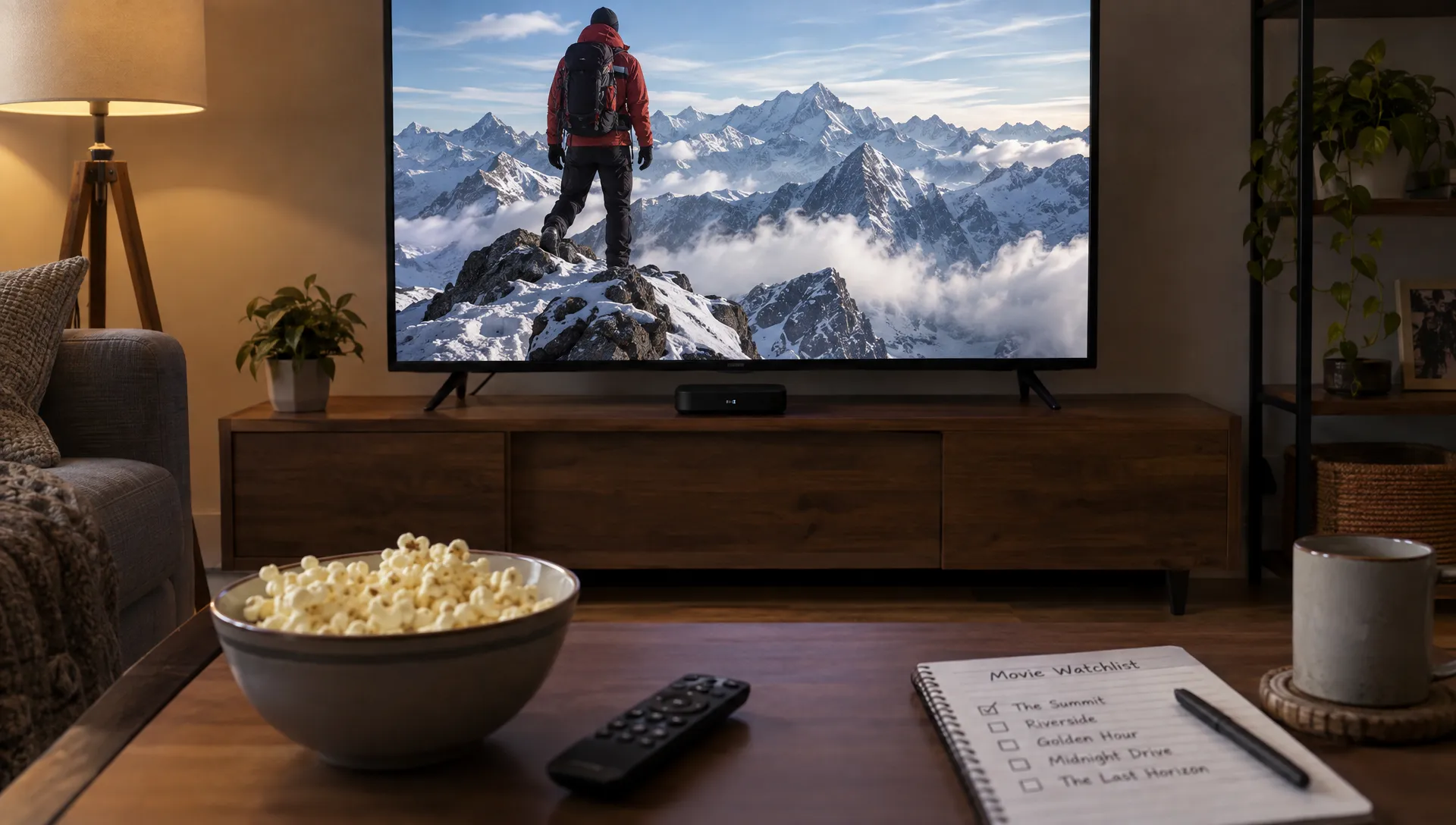
Start with a small watchlist rather than browsing an enormous catalog. Choose around ten films that represent your viewing habits: recent releases, older favorites, international cinema or movies you specifically want in 4K. These are test titles, not assumptions about what any provider carries.
Ask the provider to confirm each film’s title, release year, available resolution and audio language. A matching name alone is not enough, especially when remakes share a title or a catalog contains several versions of the same movie.
For each entry, distinguish between three things: whether the film is listed, whether it currently plays and whether it is available in the quality you want. Those are separate checks. An attractive thumbnail does not establish any of them.
The best IPTV for movies should also provide credible information about content authorization. IPTV describes internet-based television delivery; it does not establish whether a particular service has distribution rights. Ask about authorization for your country and look for verifiable licensing or distributor information. A support agent’s assurance is not independent proof.
If rights remain unclear, choose an established authorized service instead. A large catalog, payment receipt or working stream does not resolve that uncertainty.
Check movie editions, languages and completeness
Movie selection is more specific than “Does it have this title?” A theatrical release and an extended edition can differ substantially. Dubbed versions may also be separate catalog entries rather than selectable audio tracks.
When evaluating the best IPTV for movies, confirm the version you want before treating a title as a successful match. Check the release year, edition and expected runtime against information from the film’s distributor or another reliable movie reference.
A different runtime is a reason to investigate, not automatic evidence of a problem. Alternate cuts, regional versions and playback-rate differences can affect duration. However, an unexplained discrepancy deserves an answer before you subscribe.
Pay particular attention to language accessibility. Ask whether subtitles are selectable, embedded permanently in the picture or unavailable. Selectable tracks should remain synchronized after seeking, not merely during the opening scene.
For international films, confirm whether the original-language soundtrack is present. For viewers who need accessibility features, ask specifically about captions that include sound descriptions and audio description tracks. Ordinary subtitles and captions are not interchangeable.
Catalog organization also affects usability. Separate entries for different encodes or editions can be useful, but they can inflate the apparent selection. Count the films that meet your requirements, not just the number of results returned by search.
Verify 4K VOD beyond the category label
Separate video resolution from picture quality
For consumer television, UHD video generally means a resolution of 3840 × 2160 pixels. A “4K” label on a movie page is a claim to verify, not a measurement.
If the playback app exposes stream information, inspect the decoded video resolution. Your television reporting a 2160p input only confirms the signal it receives from the connected device; that device could be upscaling an HD stream.
Even a video encoded at UHD dimensions may have originated from a lower-resolution source. Resolution metadata cannot establish whether a film received a genuine native-4K transfer, and it does not reveal how aggressively the video was compressed.
The best IPTV for movies should deliver a convincing picture in actual scenes, not just display a resolution badge. Look at dark sequences, smoke, water and fast camera movement. Heavy blockiness, smeared detail or unstable gradients can make a nominally 4K stream less enjoyable than a well-encoded HD version.
Treat HDR and audio as separate requirements
4K does not automatically include HDR10, Dolby Vision or surround sound. Ask about those formats for individual titles rather than assuming they apply to the entire library.
The complete playback path must support the format: the source, app, streaming device, television and any connected audio equipment. HEVC, also called H.265, is commonly used for UHD video, so confirm decoding support when checking your device.
For a more detailed technical check, our guide to verifying real 4K IPTV explains how resolution, encoding and device support interact.
Bandwidth requirements depend on the stream’s bitrate. As a reference, Netflix recommends a stable 15 Mbps connection for its own UHD streams in its internet speed guidance. That is not a universal IPTV requirement. Ask the provider about its streams and leave capacity for other household internet use.
Test the controls you will use during a film
Live television and VOD place different demands on a service. A movie can start promptly yet fail when you seek to the final act, change subtitles or return after a pause.
If a demonstration or short subscription is available, test several films on the exact device and app you intend to use. Availability of a trial should be confirmed rather than assumed.
A practical evaluation of the best IPTV for movies includes navigation and recovery, not just five minutes of uninterrupted playback. Start at the beginning, move to the middle and check a point near the end. Then return to an earlier scene and verify that audio and subtitles remain synchronized.
| Movie playback check | What to do | What a problem may reveal |
|---|---|---|
| Startup | Open several different titles | Title-specific failures or inconsistent loading |
| Seeking | Jump forward and backward | Poor seek handling, stalled playback or broken files |
| Pause and resume | Pause, wait and continue | Session recovery or player problems |
| Audio and subtitles | Change available tracks, then seek | Missing tracks or synchronization issues |
| Completion | Check the final scene and credits | Incomplete or incorrectly labeled content |
If the app supports saved progress, close it and reopen the same film. Check whether it resumes at the correct point. Do not assume that progress will synchronize across devices; that depends on the service and player.
Repeat a problematic test before drawing a conclusion. Record the title, device, app version and approximate playback timestamp so support has something concrete to investigate. If organizing films across devices becomes your next concern, our guide to finding and managing IPTV movies covers that workflow.
Compare the cost of your actual movie habits
A subscription is not automatically better value than occasional rentals. If you watch only a few films each month, compare its total cost with authorized rentals or an existing streaming subscription that already carries your watchlist.
The best IPTV for movies is the option that fits your viewing habits without making you pay for benefits you will not use. Thousands of live channels have limited value if your priority is a small selection of high-quality films.
Calculate the full cost, including any separate player license, required subscription tier or device purchase. Distinguish the number of registered devices from the number allowed to stream simultaneously. A household may need two concurrent sessions even if only one television is used for movies.
Before paying, get clear answers about subscription length, renewal behavior, cancellation and refunds. Ask whether refunds cover technical incompatibility or unavailable content, and do not assume that testing a service creates an automatic refund entitlement.
Catalog permanence matters too. Ask how unavailable titles are handled and whether support can investigate a broken movie entry. No provider should be treated as guaranteeing permanent access to every title unless that commitment is explicit and credible.
Prefer a shorter commitment while you establish whether the service meets your needs. A lower monthly equivalent on a long plan is not a saving if the films or playback experience disappoint.
Apply these checks to BuyIPTVfor4K
BuyIPTVfor4K advertises 30,000+ live channels, 140,000+ VOD titles and streaming quality from SD through 4K. It also promotes broad device compatibility, anti-freezing technology, 99.9% server uptime, 24/7 customer support and free installation help.
Those advertised features are starting points for questions, not independent confirmation that a particular movie meets your requirements. Ask whether the VOD total counts individual films, television episodes, alternate versions or multiple encodes. Confirm which titles on your watchlist are currently available in UHD.
To determine whether it is the best IPTV for movies for your household, ask about the exact television or streaming device you own, the recommended playback app and any additional app charges. Broad compatibility language does not establish that every device supports the same HDR, audio or subtitle capabilities.
Likewise, advertised server uptime is not a guarantee that every movie asset will remain available or that every viewing session will be buffer-free. Anti-freezing claims do not remove the need to test seeking, subtitle synchronization and complete playback.
Installation assistance may help with configuration, but it is separate from content authorization and subscription terms. Confirm all three before purchasing. Evaluate the service against your actual movie list rather than treating the advertised library size as the deciding factor.
Frequently asked questions
Does a larger VOD library mean a better movie service? No. A useful library contains films you want in the editions, languages and quality you need. Advertised totals may use different counting methods, so ask what the number includes and check individual titles.
Can I watch every movie in 4K with a 4K subscription? Not necessarily. A service may offer some UHD titles while the rest are HD or SD. Your device and app must also support the available stream format. Verify quality at the movie level rather than assuming it applies across the catalog.
What is the most useful test before choosing the best IPTV for movies? Play several films from your own watchlist on your intended device. Check startup, seeking, language tracks and the final scenes. This tests the experience you will actually use, although successful playback does not establish content authorization.
Will faster internet fix all buffering? No. More bandwidth helps when your connection is the bottleneck, but server congestion, Wi-Fi instability, unsupported codecs or player problems can also interrupt playback. Test one change at a time and share specific examples with support.
Should I buy an annual plan immediately? Only after verifying content authorization, device compatibility, playback quality and contract terms. A shorter commitment can reduce financial exposure while you evaluate the service, provided the available plan suits your needs.
Build your shortlist before subscribing
Write down your must-watch films, preferred editions, required languages and playback device. Then request title-level confirmation and, where available, test those movies before committing.
If you are considering BuyIPTVfor4K’s subscription options, ask support about those specific requirements alongside licensing and payment terms. The best IPTV for movies should earn its place through verified selection and dependable playback, not a headline catalog count.