
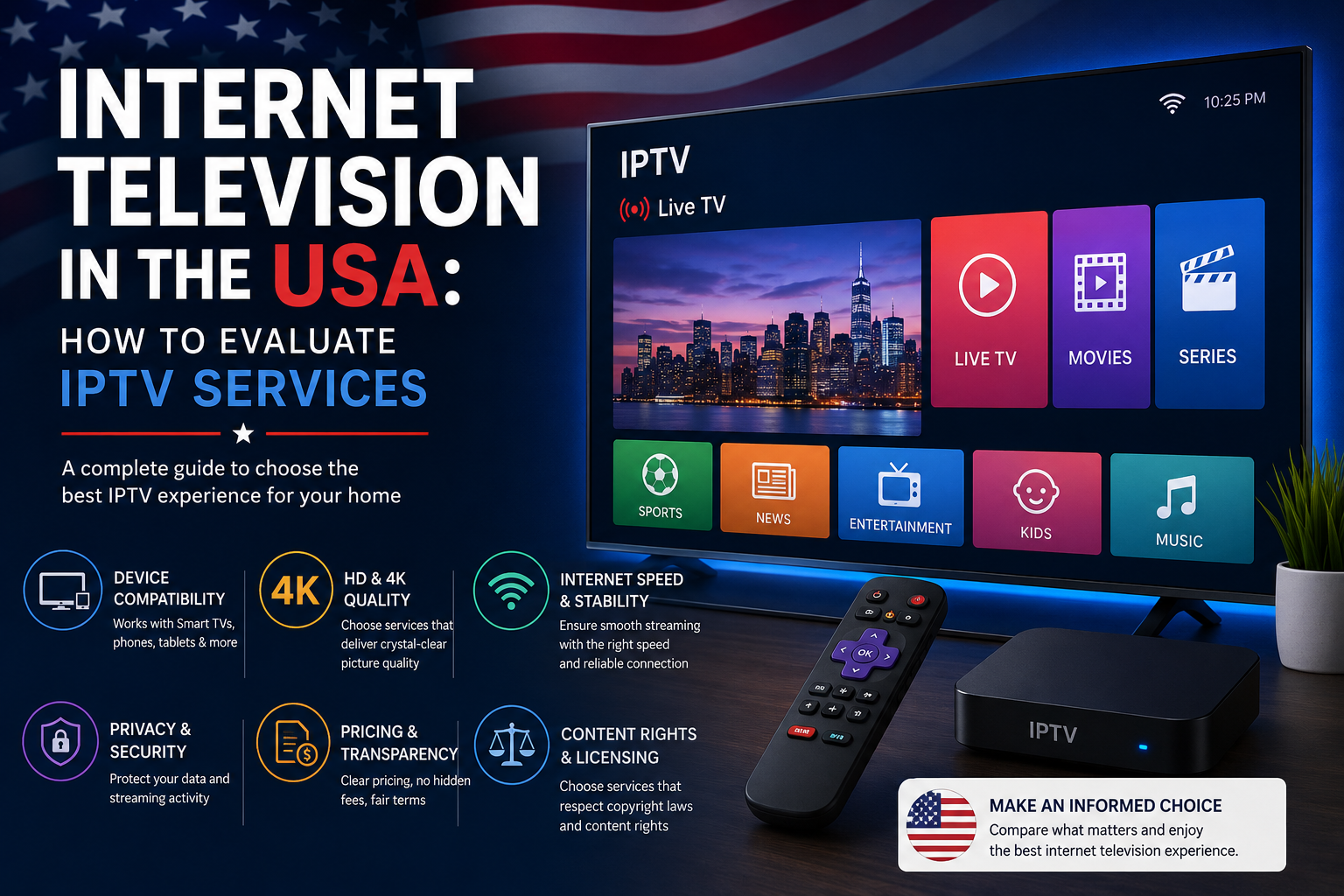
Internet television has changed the way many Americans access live channels, on-demand video, and other forms of digital entertainment. Smart TVs, streaming devices, smartphones, and computers have made it possible to watch internet-based television without relying exclusively on traditional cable or satellite services.
One technology commonly associated with internet television is IPTV, or Internet Protocol Television.
However, choosing an IPTV service should involve more than comparing prices or counting the number of advertised channels. Device compatibility, picture quality, internet performance, privacy, pricing transparency, and content rights can all affect the overall experience.
This guide explains how to evaluate internet television services in the USA and what consumers should consider before choosing an IPTV service.
What Is Internet Television?
Internet television refers broadly to television and video content delivered through an internet connection.
Instead of receiving programming exclusively through terrestrial broadcasting, cable, or satellite infrastructure, viewers can access compatible content through connected devices and internet-based platforms.
IPTV is one technology associated with this approach. It uses Internet Protocol networks to deliver television and multimedia content to compatible devices.
If you are new to the subject, our What Is IPTV? guide explains the underlying technology, supported devices, and the difference between IPTV and traditional television.
It is important to remember that IPTV describes a method of delivering content. It does not automatically indicate whether a particular service is authorised to distribute the programming it offers.
How Does IPTV Work?
The basic concept behind IPTV is relatively straightforward.
Content is prepared for digital distribution and delivered through an IP-based network. A viewer’s internet connection receives the data, while a compatible device and application process the stream and display it on the screen.
A simplified process looks like this:
- Television or video content is prepared for digital distribution.
- The content is delivered through an IP network.
- The viewer’s internet connection receives the data.
- A compatible application or platform processes the stream.
- The content appears on the television, computer, smartphone, or another supported device.
The exact technology can vary between services, but the viewer’s internet connection and compatible hardware remain important parts of the overall system.
IPTV in the USA
The US television market includes a wide range of traditional and internet-based entertainment options.
For someone researching IPTV USA, it is useful to understand that there is no single type of IPTV service. Different services can vary considerably in their supported devices, content, video quality, pricing models, and technical infrastructure.
Our IPTV USA guide provides a broader introduction to IPTV in the United States, including devices, internet requirements, and common considerations for beginners.
This article takes a different approach by focusing specifically on how to evaluate an internet television service before making a decision.
What Should You Check Before Choosing an Internet Television Service?
A good evaluation should look at the complete service rather than one marketing claim.
Here are the main areas worth examining.
1. Device Compatibility
Before considering price or content, make sure the service works with the device you actually intend to use.
Depending on the service, internet television may be available on:
- Smart TVs
- Fire TV devices
- Android TV devices
- Apple TV
- Smartphones
- Tablets
- Windows PCs
- Mac computers
Compatibility can vary between manufacturers, operating systems, and applications.
A service that works on one Smart TV platform may not necessarily work on another.
You should therefore check:
- Supported operating systems
- Supported television models
- Application availability
- Supported streaming devices
- Number of permitted devices
- Simultaneous connection rules
For users who plan to watch through a Smart TV, our IPTV Smart TV Setup guide provides additional information about compatibility, applications, and basic setup considerations.
HD and 4K Streaming Quality
Picture quality is another important part of evaluating internet television.
Services may advertise SD, HD, Full HD, or 4K content, but the label alone does not guarantee the actual viewing experience.
A genuine 4K setup requires several components to work together:
- 4K-compatible content
- A 4K-capable television
- Compatible hardware
- An application that supports the required format
- Adequate network performance
A 4K television by itself does not turn HD content into native 4K.
When evaluating a service, look for clear information about the resolutions actually supported rather than relying solely on promotional language.
You should also consider whether your preferred content is available in the resolution you want.
Why Does Streaming Quality Vary?
Two households with the same subscription can sometimes experience different results.
This can happen because of differences in:
- Internet speed
- Wi-Fi signal strength
- Router performance
- Device capabilities
- Network congestion
- Video bitrate
- Application performance
- Service-side infrastructure
This is why evaluating an internet television service requires looking at the entire streaming chain rather than focusing on the provider alone.
Internet Speed and Stability
Internet performance is one of the most important technical considerations.
There is no single internet speed that guarantees perfect IPTV performance because requirements vary according to video quality, the number of simultaneous streams, and other household activities.
For example, one person watching HD video has different requirements from a household where several people are simultaneously streaming, gaming, making video calls, and downloading files.
Our Internet Speed for IPTV guide explains how video resolution, multiple devices, Wi-Fi, and network stability can affect streaming performance.
Speed Is Not Everything
A fast broadband package does not automatically eliminate buffering.
A connection can still perform poorly if:
- The Wi-Fi signal is weak
- The router is poorly positioned
- Multiple devices are consuming bandwidth
- The network is congested
- The streaming device has limitations
- The application has technical problems
- The service itself is experiencing an issue
For this reason, connection stability should be considered alongside download speed.
Wi-Fi vs Ethernet
If your television or streaming device supports Ethernet, a wired connection can sometimes provide a more consistent connection than a weak Wi-Fi signal.
Wi-Fi can still perform very well when the router is modern and the signal is strong.
If you experience buffering, comparing Wi-Fi performance with a wired connection can help identify whether the home network is contributing to the problem.
Privacy and Security
Privacy is another factor that should not be ignored when evaluating an internet television service.
Before creating an account or providing payment information, review the provider’s privacy policy.
Look for information explaining:
- What personal information is collected
- Why the information is collected
- How customer information is stored
- How payment information is handled
- Whether information is shared with third parties
- How customers can contact the company
A professional service should make its privacy practices reasonably clear.
Consumers should also be cautious when asked to install applications from unknown or unofficial sources.
An application may technically function while still presenting unnecessary privacy or security risks.
Transparent Pricing and Subscription Terms
Price is naturally an important consideration, but the advertised price is not always the complete cost.
When comparing internet television services, determine whether the price is:
- Monthly
- Annual
- Introductory
- Recurring
- One-time
Also check whether the subscription automatically renews.
Important terms to review include:
- Renewal price
- Renewal frequency
- Cancellation conditions
- Refund policy
- Trial terms
- Payment methods
- Number of permitted devices
A low introductory price may look attractive, but understanding the full terms is more useful than comparing headline prices alone.
Content Availability
Another important question is whether the service actually offers the type of programming you want.
Consider your viewing habits.
For example, you might primarily watch:
- News
- Sports
- Movies
- Series
- Children’s programming
- International television
- Live channels
- On-demand content
A service with a very large advertised channel list is not automatically better if most of those channels are irrelevant to you.
Instead, focus on the specific content categories and channels that matter to your household.
Content Rights and Licensing
Content rights are one of the most important issues when evaluating an internet television service.
A service may technically be capable of delivering a television channel or programme, but that does not necessarily mean it has permission to distribute that content.
In the United States, copyright law protects original creative works, including audiovisual content. The U.S. Copyright Office provides official information about copyright protection and related copyright issues.
When evaluating an IPTV service, consumers should therefore look for clear information about the provider and the content it distributes.
Warning signs can include:
- No clear company information
- Unclear terms and conditions
- Extremely low prices for premium content
- Unexplained access to large amounts of premium programming
- No information about content authorization
- Anonymous or unclear payment arrangements
The important distinction is that IPTV technology itself is not the issue. The key question is whether a particular service has the appropriate rights to distribute the content it provides.
How to Evaluate 4K IPTV
4K is increasingly important for consumers purchasing modern televisions, but evaluating a 4K service requires more than looking for the words “4K” on a website.
Consider the complete setup:
Content
Is the content actually available in native 4K?
Device
Does your television or streaming device support the required 4K format?
Application
Does the application properly support the relevant resolution and video codec?
Internet
Does your network provide enough stable bandwidth?
Playback
Does the stream maintain its quality during normal viewing?
A useful approach is to test the actual device and network that you plan to use rather than assuming that a 4K label guarantees a 4K experience.
How Device Hardware Affects IPTV
Your streaming device can have a major effect on performance.
Modern Smart TVs and streaming devices can support demanding video formats, while older hardware may have limitations.
When evaluating compatibility, check:
- Supported resolutions
- Video codec support
- Hardware decoding capabilities
- Available storage
- Operating system version
- Application compatibility
If your device cannot properly process the required video format, increasing your internet speed may not solve the problem.
Reliability and Buffering
Reliability is one of the easiest factors to overlook before subscribing.
A service can look attractive on paper but still provide a poor experience if playback frequently stops or the application becomes unstable.
When evaluating reliability, consider:
- Playback stability
- Buffering frequency
- Peak-time performance
- Application responsiveness
- Customer support
- Maintenance communication
It is also important to distinguish between problems caused by your home network and problems originating from the service.
For example, if other streaming services work normally but one particular service repeatedly experiences interruptions, the issue may not be your broadband connection.
Customer Support
Customer support can be particularly important during setup.
Before subscribing, check whether the provider clearly explains how customers can obtain assistance.
Useful support options may include:
- Help documentation
- Setup guides
- Frequently asked questions
- Account support
Clear support information can also provide an indication of how transparent a company is about its service.
Internet Television vs Traditional TV
Internet television and traditional television use different delivery methods.
Traditional television can rely on terrestrial broadcasting, cable, or satellite infrastructure, while IPTV uses IP-based network connectivity.
Modern households may use a combination of both.
| Feature | Internet Television | Traditional TV |
|---|---|---|
| Delivery | Internet/IP network | Terrestrial, cable, or satellite |
| Internet dependency | Generally required | Not always |
| Device flexibility | Depends on service | Depends on provider |
| 4K availability | Service dependent | Provider dependent |
| Buffering | Can be affected by network conditions | Different signal issues may occur |
| Mobile viewing | Often possible | More limited |
| Content | Depends on service and rights | Depends on broadcaster/package |
Neither approach is automatically better for every viewer.
The right choice depends on your household’s internet connection, devices, viewing habits, and preferred programming.
Common Mistakes When Evaluating IPTV Services
Choosing Only by Price
The cheapest subscription may not offer the reliability, support, or compatibility you need.
Assuming More Channels Means Better Value
A huge channel list is not necessarily useful if it does not include the programming you actually watch.
Ignoring Device Compatibility
Always check your exact device and operating system before subscribing.
Assuming 4K Means Native 4K
A 4K label does not automatically guarantee that every stream is delivered at native 4K resolution.
Ignoring Renewal Terms
Read the cancellation and renewal conditions before paying.
Overlooking Privacy
Review the privacy policy before sharing personal or payment information.
Ignoring Content Rights
Make sure the service has the appropriate rights to distribute the content it offers.
A Simple Checklist for Comparing Services
Before choosing an internet television service in the USA, consider these questions:
- Does it support my preferred device?
- Does it offer the type of content I actually watch?
- What video resolutions are available?
- Is my internet connection suitable?
- Is the service transparent about pricing?
- What happens when the subscription expires?
- Can I cancel easily?
- Is there a clear privacy policy?
- Is customer support available?
- Does the provider clearly explain its content rights?
If several of these questions cannot be answered clearly, further research may be worthwhile before making a purchase.
Frequently Asked Questions
Is IPTV the same as internet television?
Not exactly. Internet television is a broad term for television and video delivered through internet-connected platforms. IPTV specifically refers to television and multimedia delivery using IP-based networks.
Does IPTV work with Smart TVs?
Many IPTV-related services can work with compatible Smart TVs, but support depends on the television platform, application, and service.
Do I need 4K internet for 4K IPTV?
There is no special type of internet connection called “4K internet.” What matters is having enough stable bandwidth for the video stream and other devices using your network.
Can a fast internet connection still buffer?
Yes. Buffering can result from weak Wi-Fi, network congestion, router limitations, device issues, or problems on the service side.
Is IPTV legal in the USA?
IPTV is a delivery technology and is not inherently illegal. The important issue is whether the specific service has the appropriate rights to distribute the content it provides.
What is the most important factor when choosing an IPTV service?
There is no single factor that applies to everyone. Device compatibility, content availability, streaming quality, internet performance, privacy, pricing, and content authorization should all be considered together.
Final Thoughts
Evaluating internet television services in the USA requires looking beyond attractive prices and large channel lists.
A better approach is to consider the entire experience: how the technology works, whether your devices are compatible, whether your internet connection is stable enough, what picture quality is actually available, how your personal information is handled, and whether pricing and subscription terms are clearly explained.
Content rights are equally important. Consumers should choose services that are transparent about the programming they distribute and should understand that using IPTV technology does not automatically mean that every source of content is authorised.
For additional information about IPTV, Smart TVs, internet requirements, and 4K streaming, explore the educational resources available through BuyIPTVfor4K.