
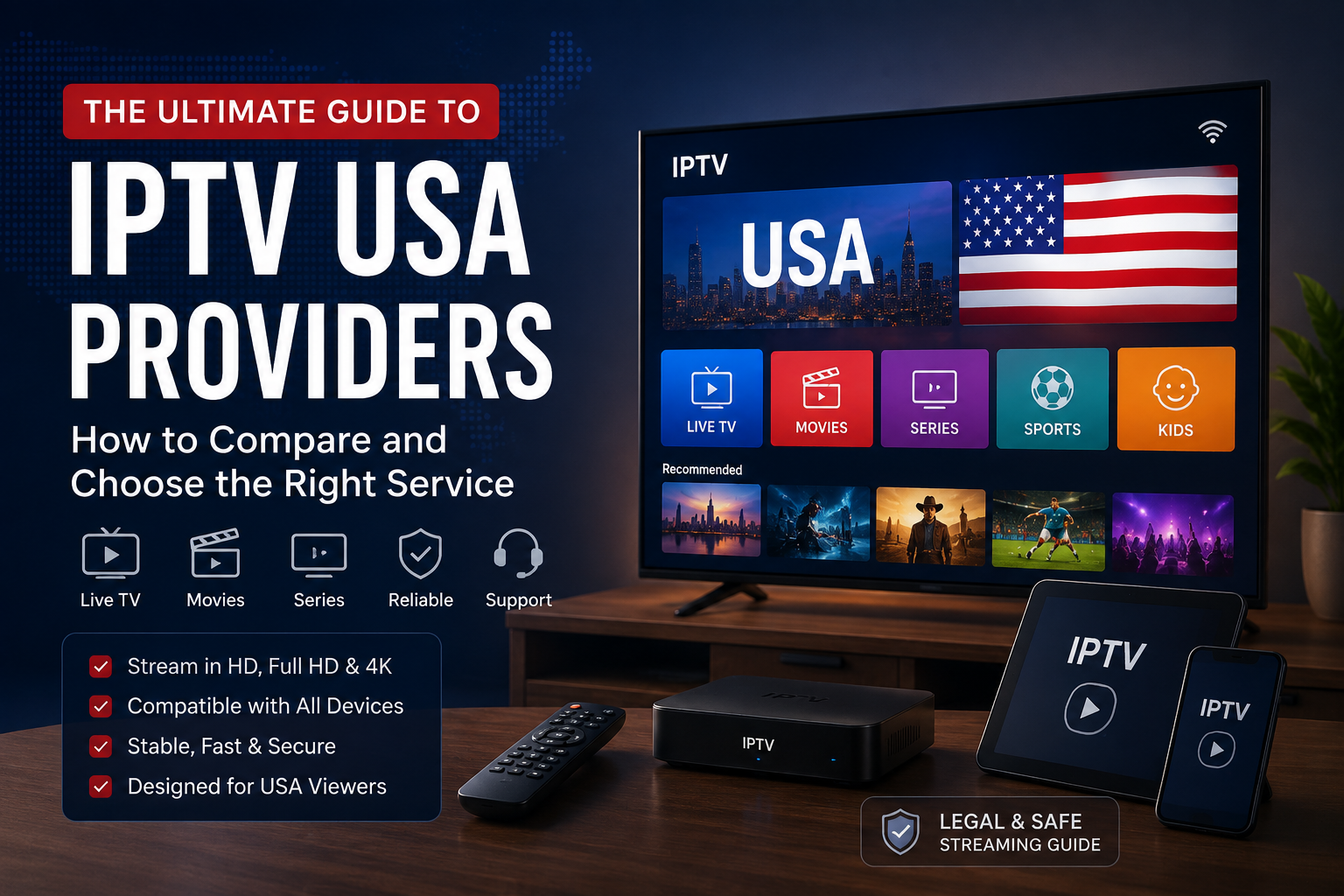
أSearching for IPTV USA providers can lead to a large number of websites, services, and subscription options. However, choosing an IPTV service should involve more than comparing prices or counting the number of channels advertised.
For viewers in the United States, important factors can include device compatibility, streaming quality, internet performance, content availability, customer support, privacy, subscription terms, and content authorization.
This guide explains what to look for when comparing IPTV USA providers and how to evaluate a service before making a decision.
What Are IPTV USA Providers?
IPTV providers are companies or platforms that deliver television or video content through internet protocol networks.
Instead of relying exclusively on traditional cable, satellite, or terrestrial broadcasting, IPTV uses an internet connection to deliver compatible television and video content to supported devices.
In the United States, IPTV-related services can vary significantly in their features, supported devices, content libraries, pricing structures, and technical infrastructure.
The term IPTV USA providers therefore does not describe one specific type of company. It can refer to different services offering internet-based television to viewers in the US.
It is also important to distinguish the technology from the content being provided. IPTV is a delivery method, while the legality and authorization of a particular service depend on how it operates and what rights it has for the content it distributes.
How Do IPTV Providers Work?
The basic IPTV process involves delivering digital video through an IP-based network.
A simplified process looks like this:
Content → IPTV platform → Internet connection → Application or device → Playback
When a viewer selects a channel, movie, or other available content, the service sends the relevant data through the internet.
The compatible application or device then processes the stream and displays it on the screen.
The final viewing experience can depend on several factors, including:
- Internet stability
- Available bandwidth
- Video quality
- Device performance
- Application compatibility
- Provider infrastructure
- Network congestion
This is why evaluating IPTV USA providers requires looking at the complete service rather than one advertised feature.
What Should You Look for in IPTV USA Providers?
There is no single feature that determines whether an IPTV service is suitable for every viewer.
Instead, consider several factors together.
1. Device Compatibility
Before choosing a provider, check whether the service works with the device you intend to use.
Depending on the provider and application, IPTV may be available on:
- Smart TVs
- Android TV devices
- Streaming devices
- Computers
- Smartphones
- Tablets
A service that works on one platform may not necessarily support another.
Check the supported operating systems, application availability, device limitations, and number of permitted connections before subscribing.
For more information about IPTV and different devices, you can also explore our guides on IPTV on PC and NVIDIA Shield IPTV.
2. Streaming Quality
Picture quality is another important consideration when comparing IPTV USA providers.
Services may advertise SD, HD, Full HD, or 4K streaming, but the advertised resolution does not necessarily guarantee the same quality for every piece of content.
Actual playback can depend on:
- Source quality
- Video bitrate
- Device capabilities
- Display resolution
- Application support
- Internet performance
If you have a 4K television, for example, the source itself must provide appropriate 4K content for you to receive genuine 4K playback.
Our 4K IPTV USA guide provides additional information about factors that can affect high-resolution IPTV streaming.
3. Internet Requirements
Because IPTV relies on internet connectivity, your home network can have a major effect on performance.
Higher-resolution video generally requires more bandwidth, while multiple simultaneous streams can increase the overall demand on your connection.
However, speed is not the only consideration.
You should also consider:
- Connection stability
- Wi-Fi signal quality
- Router performance
- Network congestion
- Number of connected devices
- Distance between the router and streaming device
Our Internet Speed for IPTV guide explains the relationship between internet performance and IPTV streaming in greater detail.
A stable connection with sufficient available bandwidth can be more useful than simply choosing the fastest internet plan available.
4. Content Availability
Content selection is naturally important when comparing IPTV USA providers.
However, a large advertised channel count does not automatically mean that a service is better.
Instead, consider what you actually watch.
For example, you may prioritize:
- US television channels
- News
- Sports
- Movies
- TV series
- International programming
- Live television
- Video on demand
A smaller but relevant content selection can be more useful than an extremely large catalogue containing content you never watch.
5. Reliability and Playback Stability
Reliability can have a major effect on the overall IPTV experience.
A service may look attractive based on its price and advertised features but still be unsuitable if streams regularly experience interruptions.
When evaluating reliability, consider:
- Playback stability
- Buffering frequency
- Peak-time performance
- Application responsiveness
- Service maintenance
- Technical support
It is also useful to distinguish between problems caused by your own network and problems originating from the IPTV service.
If other streaming services work normally on your connection while one particular service repeatedly experiences interruptions, the issue may not necessarily be your internet connection.
6. Privacy and Security
Privacy should also be considered before creating an account or providing payment information.
Review the provider’s privacy policy and look for clear information about:
- Personal information
- Account data
- Payment information
- Data storage
- Third-party sharing
- Application permissions
You should also be careful when installing applications.
Whenever possible, use official application stores or trusted software sources and keep your devices and applications updated.
7. Pricing Transparency
Price is important, but the cheapest IPTV provider is not automatically the best option.
Before subscribing, check the complete pricing structure.
Important questions include:
- Is the price monthly or annual?
- Does the subscription automatically renew?
- Are there additional fees?
- What happens when the subscription expires?
- Is there a refund policy?
- What payment methods are accepted?
- How many devices are included?
A transparent provider should explain these terms before payment rather than hiding important conditions in fine print.
8. Customer Support
Customer support can become especially important when setting up an IPTV service on a new device.
Look for clear information about how customers can request assistance.
Useful support resources may include:
- Help documentation
- Setup guides
- Frequently asked questions
- Email support
- Account assistance
Clear support information can also make it easier to resolve compatibility or account problems.
IPTV USA Providers and Content Rights
Content rights are one of the most important factors to consider when evaluating IPTV USA providers.
The IPTV technology itself is simply a method of delivering video through an IP network.
The more important question is whether a particular provider has the necessary rights or authorization to distribute the content it offers.
The U.S. Copyright Office provides official information about copyright protection in the United States.
When evaluating an IPTV service, look for transparent information about the company, its terms, and the content it distributes.
Be cautious when a service provides little information about its operation while making unusually broad claims about premium television, sports, movies, or other copyrighted programming.
IPTV USA Providers vs Traditional TV
IPTV and traditional television use different methods to deliver content.
| Feature | IPTV | Traditional TV |
|---|---|---|
| Delivery | Internet/IP network | Cable, satellite, or terrestrial |
| Internet connection | Generally required | Not always required |
| Device flexibility | Depends on service | Depends on provider |
| Video quality | Depends on source and service | Depends on provider |
| Mobile viewing | Often possible | More limited |
| Content | Depends on provider and rights | Depends on broadcaster/package |
Neither approach is automatically better for everyone.
The right choice depends on your internet connection, preferred devices, viewing habits, content requirements, and available services.
How to Compare IPTV USA Providers
A simple comparison framework can make the decision easier.
| Factor | What to Check |
|---|---|
| Content | Does it offer the programming you actually watch? |
| Quality | What resolutions are genuinely supported? |
| Reliability | Is playback consistent? |
| Devices | Does it work with your preferred hardware? |
| Internet | Can your connection handle the desired quality? |
| Privacy | Is the privacy policy clear? |
| Support | Is customer assistance available? |
| Pricing | Are all costs and renewal terms clear? |
| Content rights | Does the provider explain its authorization? |
This approach is more useful than choosing a service based solely on channel numbers or promotional pricing.
Common Mistakes When Choosing IPTV USA Providers
Choosing Only by Price
The lowest subscription price does not necessarily provide the best overall value.
Focusing Only on Channel Numbers
A large channel count does not automatically mean better quality or reliability.
Ignoring Device Compatibility
Always check your exact device and operating system before subscribing.
Assuming 4K Means Everything Is 4K
A 4K label does not mean that every channel or title is delivered in native 4K.
Ignoring Renewal Terms
Always understand how subscriptions renew and how cancellation works.
Overlooking Privacy
Read the privacy policy before providing personal or payment information.
Ignoring Content Rights
Make sure you understand whether the provider has appropriate authorization for the content it distributes.
IPTV USA Providers for Different Viewing Needs
Different viewers can have different priorities.
Viewers Focused on Live TV
Look for reliable live-streaming performance, appropriate channel availability, and device compatibility.
Viewers Interested in Movies and Series
Pay attention to VOD availability, catalogue organization, video quality, and supported devices.
4K Viewers
Check the actual availability of 4K content, compatible hardware, application support, and network requirements.
Multi-Device Households
Check how many devices are supported and whether simultaneous connections are permitted.
The important point is that there is no universal definition of the “best” IPTV provider. The right choice depends on your specific requirements.
Frequently Asked Questions
What are IPTV USA providers?
IPTV USA providers are services or platforms that deliver television or video content through IP-based networks to viewers in the United States.
How do I choose an IPTV provider in the USA?
Compare device compatibility, content availability, streaming quality, reliability, internet requirements, privacy, pricing, customer support, and content authorization.
Is IPTV legal in the USA?
IPTV is a method of delivering television and video content over an IP network. The legality of a particular service depends on how it operates and whether it has the appropriate rights to distribute its content.
Do IPTV USA providers support 4K?
Some services can support 4K content, but actual quality depends on the source, device, application, network, and service infrastructure.
Can IPTV work on a Smart TV?
Many IPTV services can work with compatible Smart TVs, but application and operating-system support varies.
Does IPTV require fast internet?
IPTV requires a suitable internet connection, and higher-resolution streams generally require more bandwidth. Stability and network conditions are also important.
Should I choose a provider based on channel count?
No. Channel quantity is only one factor. Reliability, relevant content, device compatibility, pricing, support, privacy, and content rights are also important.
Final Thoughts
Choosing among IPTV USA providers requires more than searching for the service with the largest channel list or lowest advertised price.
A better approach is to evaluate the complete experience, including device compatibility, streaming quality, internet requirements, reliability, privacy, customer support, pricing transparency, and content rights.
Before subscribing, take time to understand what the service actually offers, which devices it supports, how its pricing works, and whether it provides clear information about the content it distributes.
If you are researching IPTV technology, 4K streaming, devices, and internet requirements, you can explore more educational resources on BuyIPTVfor4K.
Ultimately, the most suitable IPTV provider is not necessarily the one with the biggest marketing claims. It is the service that matches your viewing requirements while offering transparent terms, compatible technology, reliable performance, and appropriately authorized content.